Here are a few phrases you won’t hear in our home:
Honey, next time we’re in Capri visiting our manufacturing plant can we get stay at that hotel where the bathrooms overlook the Faraglioni rocks?
Those circular soaking tubs at the Amanfayun Spa in Hangzhou, China were awesome, and I’m glad the client took us there.
Thank goodness they had clay tennis courts at my hotel in Marrakech, because cement courts would have been way too hot when Bob and I played between meetings.
This snarky intro is reflective of my reaction to an article in the latest issue of Bloomberg Businessweek. The article, The Hotel Amenities Arms Race, describes amenities at various hotels across the globe with the kicker: “Properties old and new are getting creative to lure business travelers.”
The Pool at the Qaryat Al Beri Hotel in Abu Dhabi
At first blush, it sounds interesting. I have an international job, and I like to travel. We love reading the articles, for example, in American Express’ Departures, even though we might never be able to go to some of those places. But the article completely misses the mark by providing incredibly useless information about locations that don’t really attract their share of “business travelers.”
The article cites amenities in places which global travelers frequent, such as London, New York, Hong Kong, Sydney and Paris. Sounds good. But it also includes hotels in Hangzhou, Marrakech, Majorca, Capri, and Kathmandu. These are certainly very interesting places, but are not prime business locations.
The article cites amenities such as the best points program (Starwood), business center (Park Hyatt Sydney), room service (Chambers Hotel, Manhattan), and gym (La Mamounia in Marrech) — things in which a business traveler is interested. But, the “amenities” designed to “lure” the business traveler also include a spa, bathroom, wine list, sporting venue, and golf trip. Just how is the Meydan Hotel in Dubai “luring” me there because it has a rooftop pool that allows me to swim and watch horse racing at the same time?
It’s possible people like Larry Ellison or Richard Branson would be “lured” to these places, but even they probably focus on business when they travel and certainly choose locations based on business, not based on amenities.
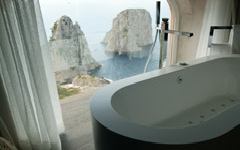
The Punta Tragara on Capri: Will Your Company Cover $2,300 per Night For This View?
The article, of course, doesn’t list prices. No worries. I looked a few of them up for you. If you are like me, they exceed your company’s hotel expense policy maximums by quite a bit:
$2,300 per night at the Punta Tragara in Capri to get the same view shown at right.
$714 per night including breakfast at La Residencia on Majorca, where, according to the article, you can ride a donkey through a forest to have a picnic of homemade foods.
$580 per night for a basic room at the Amanfayun Resort in Hangzhou, where, apparently, the spa is to-die-for.
$510 per night for a basic room at the La Mamoudia in Marrakech.
$231 per night for a basic room at the Qaryat Al Beri in Abu Dabi, where you get a temperature-controlled, saltwater infinity pool (that’s the photo towards the top of this post).
So, in summary, thanks to Bloomberg Businessweek, I know about some intriguing amenities (that few have time for on business trips) at hotels (that my company won’t and shouldn’t pay for) in specific cities (many of which almost no one travels to for business).
Seat Guru is one of the most indispensable travel sites that I have seen, yet the premise is so simple.
Seat Guru has information about the seat configuration of all the planes for most airlines. Whenever I make a travel reservation and am ready to get my seat assignment, I have Seat Guru open to the plane that I’m taking and look for the seats I want.
Seat Guru is owned by Trip Advisor, a site which certainly will get its own Thursday post at some point in the future.
You may think you don’t need Seat Guru because an aisle is an aisle, and a window is a window. You may think you don’t need Seat Guru because the web site of your travel agency or airline already has a seat map. You may think you don’t need Seat Guru because you are flying Southwest and can’t reserve a seat.
Seat Guru's Seat Map for the American Airlines 777
Wrong on all counts. Seat Guru gives you information that really helps you make an informed seat decision, even if you are flying Southwest or any other airline that doesn’t provide pre-assigned seats.
The seats are colored yellow or red if there are potential problems from limited recline, to limited space under the seat, to a misaligned window and noise from the bathroom. They are colored green if they are particularly nice for privacy or view or extra leg room. Just by holding your mouse of the seat, you can learn what the plus or the minus is.
The seat maps also show where the galleys, bathrooms, and emergency exits are and where each cabin begins and ends.
The seat maps show the row number and letter number of each seat. Airplanes routinely skip row numbers and skip letters in the seats from left to right. I pulled up the seat map for an American Airlines 777 and added it to this post as a great example. You will see that first class is rows 1-4, business class is rows 8-13, and coach is rows 20-44. First class seats from left to right are A, D, G, J, and business class seats across are A, B, D, E, G, H, J. You need the maps to know that in coach the aisles are C, D, G, and H, and to avoid E at all cost, as it is the middle of 5 seats. You also need the maps to know that row 43 is the last row, has limited leg room and should be avoided.
Seat Guru also provides you other information about every airplane. Does it have a video or audio system? Does it have electrical outlets at each seat, and do you need adapters to use the power? How much does each seat recline? How wide is each seat and what is the distance between rows (“the pitch”)? If you are choosing between airlines and are looking for comfort, Seat Guru has a comparison table for each class of service, so you can see which seats are best.
As you peruse Seat Guru, you will learn that an aisle is definitely not an aisle. Some aisles, such as the coach aisles on the American 777, have one person that would have to climb over you to get out. Others on other planes have two. When I’ve flown business class to Asia on a Continental 777, I make sure I get an aisle in the center of the plane, so no one has to climb over me when I’m sleeping.
You will learn that a window is not a window. Some windows, in fact, have no window and are colored red on Seat Guru’s seat maps.
You will see that the seat maps on airline or travel agency web sites are not nearly as helpful, for they provide no extra commentary about the seats.
And, even you are flying Southwest, I recommend looking at the seat maps to know which seats are best and possibly make plans to go after specific rows. For example, the maps show that seats in rows 1-3 are thinner have have less storage. Row 10 doesn’t recline. Seats 11D and 11E also don’t recline, but are two seats together in a row, and may seem nicer. The exit row with extra space is row 11, but only on the right hand side as you walk back. This is all information good to know before you board.
Bottom line is that this a great site. Next time you travel, go to Seat Guru, enter your airline and flight number and make a good seat decision.
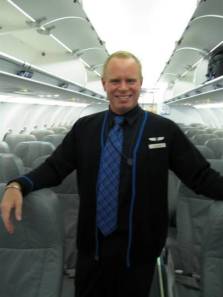
By now most of you probably have read about Steven Slater, the Jet Blue flight attendant who this past Monday, upon deciding he was fed up with his job, opened the door to the airplane he was on, pulled the emergency chute, slid down and drove away. Oh – and he was arrested hours later at his home. Oh – and he stopped on his way out of the plane to grab a beer.
Now, two days later, if you Google “Steven Slater,” you find an article on People.com and on TMZ.com. The article at People.com is “in his own words” and says Slater has developed a “cult following.” I guess this guy has made the big time, because TMZ has multiple articles and has a “separated at birth” comparison to the actor who played Gunther on Friends. There is even a “Ballad of Steven Slater.” In one Twitter post I saw “Steven Slater” used as a verb, as in “I have to go all Steven Slater now.” You’ve made it when your name becomes a verb, haven’t you?
Go Away! Please, Just Go Away!
Bobby – love the podcast since the very first one, love the blog, big supporter of flight attendants, but this post is just wrong. Mr. Slater is really your hero? We need to talk, and this is not a short conversation.
I have not celebrated this guy at all, and I wish he would just go away. Each time I hear his name, a small amount of vomit appears in my mouth.
Here’s the thing. Steven Slater is getting publicity for quitting his job, leaving his colleagues to pick up the pieces and, oh, – BREAKING THE LAW. He is charged with criminal mischief, reckless endangerment and trespassing. And we are praising this guy and looking up to this guy?
There are probably very few people on the planet that can claim they’ve like their job every single day and have never considered just quitting on the spot and telling their boss off. My guess is that many people do follow through, and many people did on Monday, just like Slater. But, most people don’t, and most people that do don’t BREAK THE LAW, leave people stranded, and gleefully flee the scene. As I see it, there’s no difference between this and a police officer or fireman or member of the military deserting their posts. Would we celebrate any of them? I think not.
I will offer a little sympathy to Slater, for I travel a lot and have seen absurdly rude passengers. But, I’m not about to excuse him for what he did. He chose his job. He could have quit at any time and not endangered passengers and not BROKEN THE LAW.
So – now is the time for Steven Slater to slink back into his New Jersey home and just go away. I don’t care, and I hope the American public quickly realizes that they shouldn’t care either. (A New York Daily News poll suggests they recognize him for what he is.)
If Steven Slater is lucky, really lucky, he may become the answer to a trivia question some day. In my eyes, that may be all he’s worth.
In yesterday’s New York Times, Susan Stellin has an excellent article about airline fees. Among other things, Stellin points out how many of the fees that exist are set at levels that exceed a reasonableness test. For example, ticket change fees, now as high as $150 for domestic tickets, are much higher in today’s online world, than they were in the days of paper tickets. The effort to change an electronic ticket would not seem to justify a larger fee.
I don’t have a problem with airlines charging fees to offset costs that they incur due to passenger behavior. For example, airlines have charged for a third piece of luggage or overweight luggage for as long as I can remember. These fees always made sense to me, because airlines let you bring on two bags already. More bags could mean more fuel and an added cost. Those that wanted the plane to carry the weight of their extra luggage should foot some of the cost. Now that most airlines charge for any bags, this fee is nearly a thing of the past.
I don’t have a problem with airlines charging fees for “extras,” such as food on very short flights, headphones or even premium meals. If you want better service or more amenities, sometimes you have to pay. I would include fees to board early in this bucket.
Where I have a problem is when airlines charge for things that make no sense. Stellin feels this way about stand-by fees, and I agree. If I am willing to wait in the hopes of getting a seat that would otherwise be empty, why does an airline have to charge? The plane is flying anyway, with or without me. If I get on, you have a seat open on the later flight. If I don’t, then you have done just enough work to put me on the list, nothing more.
Fees should be used directly to influence behavior to benefit the airlines and other passengers. If you raise the stand by fee, fewer passengers will fly stand-by. If you increase fees for checked bags, then fewer people will check bags. With that in mind, here are airline fees I’d like to see put in place immediately that, if enforced, would end stupidity and rudeness and make things flow faster. By making things flow faster, planes would leave on time, customers would be happier, and the airlines would be happier and more profitable.
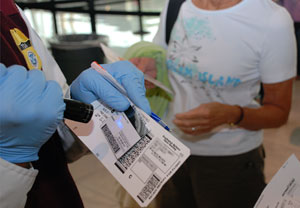
If You Don't Have Your ID Out at the Checkpoint, You Pay a Fee Under My Proposal
$50 if you can’t figure out how to swipe your credit card or passport in the ticketing kiosk. Come on! Push the credit card in and pull it out. It’s not that hard.
$25 if you do not have your identification out of your pocket before you hand the TSA agent your ticket. You have just stood in line for 15 minutes watching each person show identification to the TSA agent, but it didn’t occur to you to have your ID ready?
$100 if you have to ask the TSA whether water is allowed through security. I am reminded of the TSA agents who shout, “Ladies and gentlemen, water is a liquid.”
$150 if you hang around the boarding area before your row or group is called such that people can’t tell if you are waiting in line or not. Frequent flyers call these people lice. Just stay seated.
$25 if you try to board a plane before your group or row is called. Listen to the gate agent. Ask a fellow passenger if you need to. You aren’t special.
$50 if you have frequent flyer status and try to cut the line after general boarding starts. You know what? You missed your chance. You aren’t special either. Back of the line.
$75 for using an overhead above someone else’s seat when yours is empty – paid directly to the passenger whose space you took. If only.
$75 for not heeding a flight attendant’s request to put one bag in the overhead and one under your seat and, instead, putting both bags above your seat. Again, you aren’t special. You are one of many travelers on that flight.
$150 for putting both bags up top, hoping space will stay available and not removing one when the flight attendants say there is no more space and ask again. These people are really quite special, but not in a good way.
$50 for running up the aisle upon landing and not waiting patiently to disembark.I’ve written about this before. This one boggles my mind. Where are they going?
$100 for stopping right at the end of the jet-way upon exiting to get your bearings. When you do this, you hold up the line. Get yourself clear of the gate, and then stop to look around. You know you are in an airport. You aren’t lost.
Lastly, I’d add two new baggage fees:
$100 per bag (in addition to regular checked baggage fees), for any carry-on bag that makes it on the plane, doesn’t fit in an overhead bin or beneath the seat, and has to be checked.
$150 per bag (in addition to regular baggage fees) for any bag checked by a passenger who ignores the flight attendant’s warning that “there is no more overhead space” and continue down the aisle with their bag.
All of this is easily administered, as the airlines have our credit card on file.
Unfortunately, it makes too much sense to implement.
If you read my blog (and I hope you are a return reader), you know I travel a lot and that I like to travel. (If you are a first time reader, check Wednesday’s posts for more on travel).
For this Thursday’s “Site I Like” post, I thought I might write a few words in support of Kayak, which is my go-to site for checking airfares and hotel rates.
You may have seen some Kayak ads on television in the recent past, but those are relatively new. It’s trademark, visible in the ads, is a board that changes destinations like those old arrival and departure boards in airports and train stations. Despite the advertising, Kayak has mostly flown under the radar.
Because most of my travel is for work, and we have a corporate travel agent, I use Kayak exclusively to find out what routes exist and what low fares exist. I have to use my travel agent to book. I can’t comment on the purchase process on Kayak.
One of Kayak’s great features is that is allows you to easily narrow your travel preferences to focus on your best options, including:
Kayak TV Ad -- The Image of the Destination Board in the Background
Your preferred take off and landing times for each leg by sliding a button down a bar – much easier than a drop down box
Your preferred airline or airlines or airline alliance (Star Alliance, OneWorld or Sky Team)
The total length airport to airport of your flight, including lay overs
The length of your lay over (I hate short layovers. I like at least an hour.)
Kayak lists all the flights in a list and gives you several options to sort. At first, it shows you just the departure to destination times of all options. You decide if you want details like the flight numbers, the layovers, the fees, etc. and on which site the price is available. This allows you to do a quick scan of the best options. I usually sort by total flight time and try to find something near the top of that list.
Another neat feature is that Kayak allows you to find all trip options based on one specific flight. For example, if I’m traveling from St. Louis to Beijing and back, and I know I want a specific return flight from Beijing, I can find that flight and tell Kayak to show me all itineraries with that return flight. This feature in particular is one that other sites need to have. I often want to build my own itinerary, but don’t have that option elsewhere.
For comparison shoppers, Kayak will search five other sites simultaneously, including Priceline and Expedia. I don’t use that feature much, because I’m so comfortable with Kayak, but I can see where it might interesting to travelers.
Kayak’s hotel search is similar, in that it presents the information in a simple list, letting you decide what details you want to see. You can narrow the search based on brand of hotel, # of stars, price and amenities or any of many combinations.
Again – Kayak works for me, especially in terms of how quickly I can scan and sort options. Other sites may work for you. But, if you haven’t visited Kayak and you tend to research fares, you really should give Kayak a try.
For this week’s travel post, I thought I might run down a few things that I highly recommend you don’t do on an airplane. I’ve traveled for every job I’ve ever had. For some, I’ve traveled every week. I’ve been packed in the center seat between New York and London on a 747 and in first class on a 777 from Berlin to DC. I’m not afraid, like some, to fly Southwest and remember to get my A boarding pass 24-hours early.
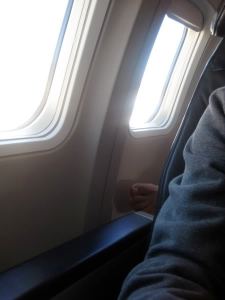
Don’t Show Me Your Bare Feet
I have no issue with people wearing sandals, flip-flops or other shoes without socks. I wear flip-flops almost exclusively from May through September, except when I’m at work. I don’t mind if you slip them off on the plane. I just don’t want to know. Don’t cross your legs and put your foot up at armrest level, almost touching me. And please, please don’t put your bare foot on the armrest when you sit behind me, so that your toes brush against my elbow. Yuk! I borrowed the photo at right from my friends at upgrd.com, who experienced something very similar last fall.
Please Don't Do This!
Don’t Bring Smelly Food on Board
Seriously. No one wants to smell your tuna or your Italian sub. You don’t think we can? Bring a PB&J, or chips. It was awful to smell Lynch Parsons’ liverwurst in 2nd grade, and it’s awful to smell your stuff now. At least in 2nd grade, I could sit on the other side of the cafeteria. I can’t move when I’m on a plane.
Don’t Eat Food with Disposable Parts
I wasn’t sure how to name this. I once sat on a plane from St. Louis to Orlando in an aisle seat. Right across the aisle from me, a guy ate sunflower seeds the entire trip. He put one in his mouth, bit it, reached into his mouth to grab the shell, and put the shell on a napkin on his tray. I appreciate his neatness, but after 45 minutes he had a nice large pile of wet sunflower seed remnants. It was disgusting. Don’t do this. Don’t bring peanuts or anything like this.
Don’t Expect Your Child to Entertain Themselves
I am constantly amazed at the people who travel with kids that bring nothing to keep the kids entertained. No coloring books. No toys. No books to read. No DVD player. No nothing. When was the last time a 5-year-old sat still for an hour? Never. As a result, they kick the back of my seat or cry a lot. I’m a parent of two, and my kids have flown since they were in baby carriers. My wife, bless her, always prepared for every trip with stuff. Once, we flew from Baltimore to Honolulu for my sister’s wedding via Detroit and San Francisco. My kids were 4 and 1 1/2. My wife packed wrapped presents to be open about every 90 minutes. My kids didn’t bother anyone.
Don’t Hog the Arm Rest or Think You Can Keep It Up the Whole Trip
This is all about sharing. You take the armrest for a bit, then I’ll take it, and so on. I can’t stand it when someone plops down, puts their arms on the armrests, and doesn’t move for two hours. Meanwhile, my left or right arm is cramping by the time we land. (By the way, my wife vehemently disagrees with this. She thinks the person in the middle seat gets both their armrests as “compensation” for taking that seat.) And for those of you slightly larger that don’t want the armrest down – nope. You have your space, and I have mine, and the armrest separates that space. If I sit down, and the armrest isn’t down, it goes down immediately.
Don’t Put Your Baggage Over My Seat, When Your Seat is 20 Rows Back
Your baggage goes over your own seat. That’s why there’s overhead space above your seat. The overhead space over my seat is mine. I’ve actually stopped people from using my space, when I see them do it. I’m sorry you can’t carry the bag all the way back. Next time, get a seat farther up front.
Don’t Talk the Whole Trip Behind Me or In Front of Me
I can usually control the conversation in my row. Sometimes I’m in a talking mood, and sometimes I’m not. I get frustrated however, when the people in rows around me talk incessantly the whole time. Rows in coach aren’t that far apart. Voices carry. Be sensitive. Two hours of non-stop chatter gets to me.
Don’t Play Your DVD Without Headphones
You can afford a DVD player but not headphones? Nothing much more for me to write here.
Don’t Rush Up the Aisle When the Plane Lands
This one kills me. Where the hell are you going? Three rows make a difference? I am amazed when this happens on international flights. People run up the aisle to save four rows, and they have to go through passport control anyway. You exit a plan row by row, just like on a school bus. Be considerate. When I see someone standing above me that I know came from a few rows back, I stare them down and make sure I get out when it’s my turn. Sometimes, I’ll even block to let row mates out.
This has been a public service announcement from all the frequent flyers to you infrequent flyers. Thanks for reading.
In last week’s Travel Wednesday post, I detailed five tips for future travelers on Royal Caribbean’s Freedom of the Seas. My family and I spent a week on the Freedom of the Seas in late May and early June, traveling to Haiti, Grand Cayman, Jamaica and Cozumel.
This week, I conclude my list, with an additional six tips.
1. Get up early if you want lounge chairs near the pool on the days at sea
Despite a “guest conduct policy” that prohibits saving chairs and signs that say attendants will remove personal items left on an unoccupied chair for more than 30 minutes, we never saw any issues with saving chairs. However, we did see many people disappointed by 9:00am when the only chairs they could find were either in the shade or on deck 12, one level above the pool, where the wind is fierce. Getting there early is even more critical if you want chairs by the adult pool. These are premium seats for the quiet and for the chair cushions which aren’t available at other pools.
The Adult Pool on the Freedom of the Seas
Our cruise had two days at sea, and on both days we got up around 8:00 and put out towels, magazines, sun tan lotion and other markers to stake our claim on two lounge chairs near the adult pool. By the time we finished breakfast and made it up to our seats around 9:30, all the chairs were long gone. No one had disturbed our stuff, and we settled right in. We recommend making friends with the people near you, so that you can protect each other’s chairs when you step away for food, a massage, or to gamble.
I’ve seen other reviews that suggest our behavior is revolting and mean-spirited. Sorry. I spent a lot of money on this vacation, and I got up early to get the seat I want. If you want a better chair, get up earlier than me.
2. Book your own excursions
We booked excursions in Jamaica and in Cozumel on our own, not through RC. We found both excursions through Trip Advisor and found the reviews to be accurate. In one instance we had a better time and saved money, and in the other we did something that RC doesn’t offer.
On Jamaica, we booked a day-long tour that included climbing Dunn’s River Falls, a tubing trip down the river, and a stop for lunch. Our guide, Phil Lafayette, kept us entertained with his stories and his narration of the surroundings. When rain washed out the tubing trip, he took us to nearby areas for more sightseeing, and he reduced the cost. The cost should have been $55 per adult and $45 per child under 11. We found similar trips offered by RC that were double the price. Finding Phil at the dock was easy, and we were one of seven or eight families that did the same thing. (By the way, if you haven’t climbed Dunn’s River Falls and you are physically able to do so, I highly recommend it.)
On Cozumel, we participated in the Amazing Cozumel Race. This is offered by Carnival, but not yet by RC, so we booked it ourselves. We walked, swam, and ran 3.5 miles through and around downtown Cozumel in 90 minutes, moving from clue to clue as in the television show Amazing Race. We finished third, behind a group of four 20-somethings and behind another family with older kids. It was nearly 100 degrees, but, except for a bit of family bickering at the clues, we really enjoyed ourselves. The race was inventive and challenging. The cost for the four of us was $268.
3. Get private lessons on the Flowrider
The Flowrider lives up to expectations. Located on deck 12 at the rear of the ship, the Flowrider is a “ride” in which water pulsating very fast up an incline provides resistance to allow “riders” to surf or boogie board. As you might imagine, the lines get very long, especially during the days at sea. At about five minutes per surfer or boogie boarder, it takes a while to get through the line.
For $60 per person, you can take private lessons on the Flowrider. We signed our son up for surfing and our daughter up for boogie boarding. At 9:00pm on the second night, they had one-on-one instruction in a group. For example, my son was one of four surfers for the hour, but each time he was up, he worked directly with an instructor. During the lessons, the surfers and boogie boarders can use the whole Flowrider each time, whereas during the day, the Flowrider is divided in half to allow more people to use it. After the lessons, both kids qualified to attend “expert sessions” early in the morning when lines are shorter. We can’t recommend these lessons enough. Below is video from our kids lessons.
4. Get a “cabana chair” in Haiti
Unfortunately, we found information lacking about RC’s private beach at Labadee, Haiti. We checked for maps at guest services and asked around, but could learn almost nothing. The head of the excursions desk on deck 5 knew zero! I want to pass one thing on to you.
When you get off this ship, go straight and take the path almost as far as you can take it. By walking straight and far, you come to a less rocky area, from which you can swim. However, you will also find “cabana” chairs. These are two normal chairs pushed under a half-moon, umbrella like cover that provides shade and a bit of privacy. They are first-come, first-serve. If you don’t care about swimming, then find some shade under a tree. But, if you want to swim and want shade to relax, go directly for a cabana chair.
5. Return to the ship earlier than normal in Grand Cayman
Grand Cayman is a tender port. This means that you go from ship to tender (a boat) to the shore. At all other ports, you can just walk off the ship. These tenders become natural bottleneck as they fill up with passengers and leave the dock. The line quickly gets long and winds through the port area. When the sun is hot and the line moves slowly, it’s no fun. If we had to do it over again, we’d head back to the boat on the earlier side to avoid the lines and take advantage of quiet on board ship.
6. Depart on your own terms.
After going through departure, I have two tips.
First, don’t forget to fill out your departure times on a slip in the room. We forgot and ended up in group 20, which was scheduled to leave at 8:30am. We were in no rush, but 8:30 was just too late. There is commotion all over the ship. As a result, it’s nearly impossible to sleep late. I recommend something around 7:30 or 7:45. Remember to fill out your forms and leave on the earlier side.
Second, if you are antsy, you don’t have to wait for your number to be called to leave. The departure group numbers are the order in which luggage is delivered to the baggage area. It is not a limiting factor on when you can leave the ship. If you are in group 20 and want to leave with group 1, you can. However, you are stuck in the baggage area until your bags come out. Although we were group 20, we departed when they called group 15, and only had to wait a short time for our bags. Not one person asked us what our group number was except the person directing us to the right luggage carousel.
I hope this week’s and last week’s tips are helpful. If you have other questions, post a comment and I’ll answer as best I can.
Following up on Travel Wednesday, I’m going to focus this Blogosphere Thursday post on a travel blog worth visiting.
I’d like to stipulate that I really like to travel. It’s not just about the destination for me, it’s about the experience. I don’t really mind the lines or the process.
I’ve been fortunate in that business travel has often allowed me to collect enough miles to earn status privileges (silver, gold, platinum, etc.) on airlines. This lets me board early, get upgrades and bonus miles. With the miles I earn, I’m often able to redeem them for first class travel. To me, the whole frequent flyer thing is a game and a challenge. I like figuring out how to collect more miles to get even better status to get even more perks.
If you are like me, you need to follow the group of guys at Upgrd.com. I wish I could recall how I stumbled upon this site, but I’m happy I did. I also listen to their podcast where the personalities of the key participants (Matthew, Mike, Ben, Hunter, Josh, Fozz, and Gary) all come out.
So, what can you learn from Upgrd.com?
Ins and outs of the various frequent flyer programs, including how to redeem, how to get bonus miles, what status levels get you, and what to do with your miles in the case of an airline merger.
How to make sure you get an upgrade, which is a whole science in itself.
Why volunteering to take a later flight when yours is oversold can be a good thing and how many miles to request.
All about “mileage runs” and how to build them. A “mileage run” is a trip someone takes only to earn miles. There is a rule of thumb that if your miles “cost” less than 3 cents (cost of fare divided by # of miles), then it’s a good deal. It may be worth spending a day, for example, on a quick round trip between St. Louis and Los Angeles.
Descriptions of the various cabins on different airlines, airport clubs, hotels, etc.
Stories about the traveling experience.
As an example of something I’ve learned recently — Delta now has a special only out of St. Louis and a few other cities that lets you get your status faster and provides bonus miles. To get that, however, you have to sign up for the program. I did, thanks to a tweet from Gary at Upgrd.com. Because I’m based in St. Louis, and we have to connect to get anywhere, I’ll be tempted to make the next trip on Delta to maximize the miles as long as it doesn’t take me too far out of my way.
Another thing I learned from these guys are the concepts of “status matching” and “status challenges.” Status matching occurs when one airline matches the status you’ve earned at another, usually as an incentive to get you to fly them. When I got to Continental Platinum last year, I was able to get Delta Platinum in just 24 hours with a simple email – and I hadn’t flown Delta in years. Status challenges allow you to get to status levels faster by flying a large amount of miles in a short time (and paying a small fee). Challenges are good if you’re flying patterns move you to a different airline for an extended period, such as when you start servicing a new client or are on a new project in other cities.
For those of you that don’t think about all this stuff, but fly a lot, it may be worth visiting and possibly subscribing to the boys at Upgrd.com.
In late May/early June, our family went on a one-week cruise on Royal Caribbean’s Freedom of the Seas. The cruise left Port Canaveral in Florida and went to RC’s private beach in Labadee, Haiti, to Jamaica, to Grand Cayman, and to Cozumel. There were also two days at sea. We thoroughly enjoyed ourselves and recommended the cruise to families and couples.
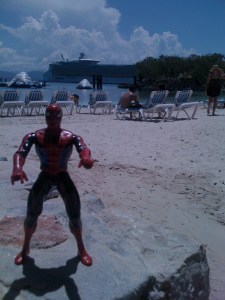
Spidey on Labadee, Royal Caribbean's Private Beach on Haiti
The Freedom of the Seas is one of the Freedom Class of ships from Royal Caribbean and was the largest cruise ship in operations from its launch in 2006 until the Oasis of the Seas was launched in 2009. The Freedom of the Seas has a capacity of 3,634 passengers and 1,300 crew. It cost $800 million to build.
Rather that do a straight review (there are 412 such reviews at Cruise Critic), I thought I would share with you, over two posts, some tips for after you decide to take a cruise on this ship. Let’s start with food, since that is often (always?) the central point of cruises:
1. Buy Bottles of Wine Not Individual Glasses
My colleague Mike told me about this before we left, and he was right. Glasses of wine in the dining room can be expensive – in the $15 range. However, if you know that you want wine every night and don’t mind the same wine for two nights or more in a row, buy a bottle. At the end of the meal, your waiter marks the cork with your table number, takes it away, and then brings it back the next night for you to finish. Since we had only two drinkers (my wife and I), this worked better than the RC Wine Plan, where the fewest number of bottles you can buy is five. The per bottle cost of the Wine Plan is less than we paid, but we couldn’t have possibly drunk five bottles in a week.
2. Try the Buffet for Dinner
The food in the dining room is generally very good, and the service has a nice pace to it. However, I urge you to try the buffet for dinner at least once. After a long day in Cozumel, we decided to hit the buffet for dinner and were pleasantly surprised. Before even considering the food, there are four clear pluses of the buffet: 1) you can wear whatever you want (no need for long pants), 2) you can eat as fast or as slow as you want, 3) you can try a lot more things, and 4) you get a great view up on the 11th floor, compared to the 3rd, 4th, or 5th floor views from the dining rooms. We found the food to be of great variety and very tasty. They had everything from sushi to Indian to pasta to burgers and pizza. I had an ice cream sundae for desert. It was a great way to start a relaxing evening.
3. Get the Early Dining Seating for Dinner
Yes, this tip may just reflect our preference, but 8:30pm is just too late for dinner for us. If you get the 6:00pm seating, you can go as late as 6:30 and have no problems. Since it takes at least 15 minutes to get your food, you are really eating at 6:45. As far as the “My Time Dining,” which gives you flexibility: we found that there was a lot of scrambling by those families to pick a time every day. 6:00pm dining also means you see the shows after dinner, which fit our schedule.
This worked for us, but we are pretty big Diet Coke/Diet Pepsi drinkers. The cost is $6 per day for adults and $4 per day for kids. If you don’t buy the package, each soda is $1.50 plus 15% gratuity. On the first day of the cruise, they offered the soda package at a discount, so I would wait to buy on board. Unfortunately, there’s no self-serve soda, although I hear that’s coming. Instead, you have to go to one of the bars and show your room key with a sticker that identifies you as having purchased the soda package. We bought two – one for my wife and me and one for our two kids. You could always flash someone else’s card with the sticker to get a soda, so sharing is definitely possible. $6 per day = 4 sodas per day or 2 sodas per person, which is well below our normal drinking rate. We certainly exceeded that and got our money’s worth.
That’s it for food tips.
Let me add one other tip and then save the rest for next Wednesday:
5. Prepare to be Disconnected
Royal Caribbean claims to have mobile phone service for those whose phones support GPRS. However, I found the data service on my iPhone to be very spotty and completely unavailable for the last day or so. I could make calls, in theory, but any data service from email to texting to Twitter just didn’t work most of the time. In my case, work paid for the international service, but I would check your rates to see if it is even worth it. As far as Internet, you can get access, but it is very expensive — $0.65 per minute or packages such as $150 for 500 minutes. Those minutes go fast if you have two kids like mine that live on Facebook. There are no newspapers on board, so the best you can do is CNN Headline News, which gets boring after a while.






 Life With Spidey