In Praise of [name your sport]-Reference.com

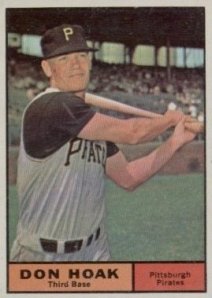
In the movie City Slickers, there is an early scene where one of the wives says, “I’ve been to games, but I don’t memorize who played third base for Pittsburgh in 1960 .”  At that point, the characters played by Billy Crystal, Daniel Stern and Bruno Kirby answer in unison, “Don Hoak.”

This has always stuck with me as the epitome of us guys (and some girls) who can’t remember the date we proposed to our spouses, but can remember absurd sports facts.
Don Hoak - Who Knew?

I didn’t know who played third base for Pittsburgh in 1960.  That’s a bit before my time.  However, I do enjoy perusing a lot of meaningless sports statistics and information.  I’m intrigued by what teams players played for, when they were traded and for whom, what numbers they might have worn and other data.  Before all this stuff was on the Internet, Mrs. Spidey bought me a 10-pound book called “The Official Encylopedia of the National Hockey League,” which listed statistics of every player who ever donned an NHL uniform, including their stats in minor leagues and other countries before and after they played in the NHL.  It was fascinating.

Now you can get all this meaningless, yet fascinating drivel on-line, not just for the NHL, but for major league baseball, the NFL and the NBA.  What do I consider “meaningless, yet fascinating drivel?”  Data varies by league, but here are examples:

  • Uniform numbers worn by every player for every team on which they’ve played. Don Hoak wore #43 for the Brooklyn Dodgers when he first came up, but later wore #7 with the Cubs and then #12 for the Reds, Pirates and Phillies.
  • All signings and trades involving each player, including for whom they were traded and who was chosen by future draft picks.  Don Hoak was traded to the Pirates by the Reds in the same deal with Harvey Haddix, who is known for pitching 12 innings of perfect baseball in 1959 and then losing the game in the 13th inning.
  • Whether each player was an all-star, won an MVP or other award, or ranked in annual statistics. Thanks to Baseball-Reference.com, I now know that Don Hoak was 2nd in the MVP voting in 1960, behind teammate Dick Groat, but ahead of more famous players such as Willie Mays (#3), Ernie Banks (#4) and Roberto Clemente (#8).  In that same year, Hoak was 6th in the league in walks, 9th in on-base percentage, 7th in runs scored,  and 10th in RBI.

Enough about Don Hoak – I think you get the point.

With all the links back and forth, I could live on these sites for a long time.  These are among the few sites for which I might actually carry a laptop into the bathroom to substitute for a book or newspaper.

Here are a few other stupid jersey #  facts to whet your appetite for more:

  • Phil Esposito, who wore #7 for the Blackhawks and Bruins and, later #77 for the Rangers, briefly wore #12 for the Rangers for 76 games in 1976 after being traded. #7 was worn and later retired for Rod Gilbert.
  • Hank Aaron’s first jersey # for the Milwaukee Braves in 1954 was #5, before he switched to #44 for the rest of his career in 1955.  No one on the Braves wore #44 in 1954, and no one other than Aaron would after 1955.
  • Mickey Mantle first wore #6 for the Yankees, before switching to #7 midway through the 1951 season.
  • Michael Jordan wore #45 for the Bulls, upon his return from a year of minor-league baseball.  Bizarrely, he couldn’t wear #23, because it had been retired – for him!
  • Franco Harris, the Hall-of-Fame running back for the Steelers in the 1970’s and 1980’s, finished up with the Seahawks in 1984 where he wore #34, not his traditional #32.  #32 was worn that year by Cullen Bryant.  Go figure.

So – before you click on the links below, please tell your spouse or roommate that you’ll be out-of-touch for a while learning about Reggie Jackson’s time with the Orioles in 1976 and Frank Robinson’s short stint with the Dodgers in 1972, learning which World Hockey Association team Wayne Gretzky played for before Edmonton, and finding out that Bill Russell was actually drafted by the St. Louis Hawks and traded on draft day to the Celtics for Cliff Hagan and Ed Macauley.

Enjoy.  Here are the sites:
Hockey-Reference.com

Baseball-Reference.com

Basketball-Reference.com

Pro-Football-Reference.com

Baseball Owners, Why are You Helping the Yankees?

I am a die-hard Yankees’ fan. As a Yankees fan, I’m excited by their pick-ups before the July 31 non-waiver trade deadline, but I am very surprised by what was exchanged in the deals.

Typically, when you see a team make a trade to pick up an impact player, they have to give something up.

Here in St. Louis, the Cardinals had to do just that, giving up starting right fielder Ryan Ludwick to get starting pitcher Jake Westbrook, whom the Cardinals believe will complete their rotation through the end of the season.  Ludwick was a Silver Slugger winner in 2008 and was hitting .283 with 11 HR and 43 RBI at the time of the trade.  More importantly, perhaps, Ludwick was, by all accounts, an exceptionally positive force in the Cardinals’ clubhouse.  Westbrook is a sub-.500 career pitcher, who is 6-7 with a 4.65 ERA in 2010.  The Cardinals wanted him, however, so they had to give up value.

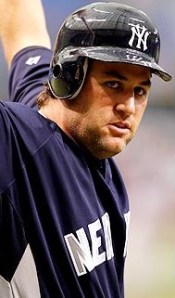
Lance Berkman in His New Yankees Uniform

In Los Angeles, in order to get Ted Lilly for their rotation, the Dodgers had to give up their starting second baseman, Blake DeWitt, and two minor leaguers.  DeWitt is only 25, has a .980 fielding percentage at second base, and was hitting .277 at the time of the trade.  For this up-and-comer, the Dodgers got Lilly, 3-8 with a 3.69 ERA this year and a free-agent at the end of the season, and Ryan Theriot, the Cubs starting second baseman, a bit older than DeWitt and hitting .283 with only 21 RBI when traded.  To compensate the Dodgers for the loss of a potential superstar, the Cubs also shipped the Dodgers $2.5M to cover some of Lilly’s remaining salary.

To their credit, the Yankees picked up three strong role players for their stretch run:

  • Lance Berkman from the Astros, a switch hitting first basement and designated hitter. Berkman is a career .296 hitter, a five-time all-star, and a good first basemen with a fielding percentage of .995 in 2009.
  • Austin Kearns from the Indians, a steady outfielder and possible designated hitter. Kearns is a lifetime .258 hitter, but he was hitting .272 at the time of the trade and has a career .986 fielding percentage playing all three outfield positions.
  • Kerry Wood from the Indians, who will be given the opportunity to take on the 7th or 8th inning set up role for closer Mariano Rivera. Wood is having an unremarkable season and is just off the disabled list, but consistently has more strikeouts than innings pitched throughout his career.

Unlike the Cardinals and Dodgers, however, the Yankees didn’t give up a single player on the major league roster:

  • For Berkman, the Yankees gave up a AAA relief pitcher Mark Melancon, who has appeared in a total of 25 major league games in his career, and Jimmy Paredes, a minor league shortstop at the A level.
  • For Kearns, the Yankees traded a “player to be named later.”
  • For Wood, the Yankees traded a “player to be named later” or $500,000, if the Indians decide against a player

    Kerry Wood Pitches in His First Yankees Game

Let’s delve a bit deeper into the trades.  The Astros also gave the Yankees $4 million towards Berkman’s remaining 2010 salary of $5.5 million and a $2 million buyout.   The Indians also gave the Yankees $2,172,131 towards Woods’ remaining 2010 salary of $3,672,131.  The Indians did not give any money along with Kearns, but, then again, his entire 2010 salary is only $750,000.

I find this amazing.  The Yankees already have the largest payroll in the major leagues ($206 million in 2010), the most revenues (between $450 and $500 million in 2009), and likely turned a profit even with other operating costs.  Yet the Astros, with $189 million in 2009 revenues, and the Indians, with $170 million in 2009 team revenues, both sent the Yankees money.

Why?  Rational economics suggest the Astros must want to save the $3.5 million they will with Berkman, and the Indians must want to save the $1.5M they will with Woods. The other possible answer is that Yankees’ competitors are in such poor economic shape that they can’t afford the $3.5 million the Yankees will pay Berkman and the $1.5 million the Yankees will pay Woods.  I find either difficult to believe.  All deals end in 2010, so there is no savings or extra payments beyond this season.

In the end, Yankees gave up very little to make themselves much stronger for the stretch run.  ESPN, NBC Sports, Yahoo! Sports, and Sports Illustrated all list the Yankees among the trade deadline “winners.”  In my opinion, they were basically paid to take these players.  Could the Jimmy Paredes for Lance Berkman deal work out as poorly for the Yankees as the Curt Shilling for Glenn Davis deal did for the Orioles back in 1991?  It’s possible, but it will take years to know.

For all the complaining about the lack of a salary cap and complaining about how the Yankees buy championships, I’m amazed that other teams are willing to ship the Yankees money to help them make their team better on another championship run.  To me, it doesn’t make sense.  Good for Brian Cashman, Joe Girardi and the Yankees.  Shame on the rest of the league.

T.O. to STL? NO!

I was stunned to learn towards the end of last week that the Rams are apparently interested in signing Terrell Owens.  I was truly incredulous.

I am so hoping that in this age of Twitter-based, light-speed rumor mills, that this is a joke.  I’m not the only one.  Bernie Miklasz of the St. Louis Post Dispatch thinks the Rams are nuts.

I was surprised, however, to see both Mike Sando of ESPN and the much respected Peter King of Sports Illustrated write that it isn’t a terrible idea.  And the online, very unscientific vote at STLToday, showed local fans in favor of signing T.O. by 53% to 47% as of the morning of July 26.

The positive spin on signing T.O. is that a team can get a very talented wide receiver for lower than market prices.  As I see it, Owens is desperate to find a team willing to take him.  In theory, T.O. is a player looking for redemption, wanting to show a new team, the league, and the public that his team and the world know longer revolves around him.  It’s a often-told and often-seen tale in professional sports, but it rarely comes true.  Players that are difficult to work with tend to stay difficult to work with throughout their career.

The Rams Do Not Need the T.O. Distraction This Season

The downside with T.O., in my opinion, is much more significant.  T.O. will be a distraction for the Rams.  Even if he tries to stay out of the limelight, the local and national press will suck him back in.  Eventually he’ll say something he shouldn’t, and disarray will result.  The Rams, under second-year coach Steve Spagnuolo need peace and quiet at training camp.  The Rams need to take things slow and steady and build a nucleus around this years #1 pick Sam Bradford.  The Rams need to be Bradford’s team from the get go.  Owens presence at camp and on the field will simply not allow that to happen.

Even more so, it appears that T.O. is on the downside of his career.  He hasn’t been to the ProBowl since 2007, which is also the last year that he was among the statistical leaders at wide receiver.  Take a look at his career stats.  After three  years with more than 90 receptions with the 49ers, Owens has not exceeded 85 receptions in a year since 2003, and his number of receptions has declined every year since 2006.

In the age of free agency, smart owners and general managers have learned that championships are won by teams and not by individual players.  These same team executives have learned that you can rarely go from last place to first place in one year.  Teams like the Chicago Blackhawks, the Washington Capitals, the Orlando Magic, and the Dallas Cowboys have had woeful seasons in which they retooled before advancing to the tops of their leagues, and, in the Cowboys’ and Hawks’ case, to the championship.

What does Billy Devaney, the Rams General Manager, gain by signing Terrell Owens?  Does he sell a few more tickets?  Does he attract a bit more national press?  Does he win a few more games?  Perhaps, but to me it doesn’t matter given the downside.

The 2010-2011 season for the Rams is about building for championships in future years, which means building a team.  I really don’t believe that # of wins is a top goal for the Rams this year. Their goals should center around educating and gaining experience for their young nucleus and building a cohesive unit in which the sum of the parts is greater than the individuals.

There is no way that T.O. fits into that plan.  Rams –  please stay away.

The Day I Gave George Steinbrenner Advice

George Steinbrenner and I have two things in common. We are both alums of Williams College, 1952 and 1988 respectively, and we both love the New York Yankees.

The former brought us together in the fall of 1984.

I was a freshman at Williams then. Both my freshman roommates played football. Both were running backs. I don’t think either played all four years, but on this day, homecoming 1984, my roommate Kenny started at halfback against our arch rival Amherst.

The record shows that Williams lost that day 23-6 and that Amherst completed an undefeated season. It wasn’t until my senior year that we next beat Amherst in football, starting a streak of eight victories in a row.

I’ll remember that day, however, because that day I gave George Steinbrenner advice about the Yankees.

I had found a spot in the stands around the 40-yard line, wanting to watch Ken, rather than join the tailgaters just off the end zone at Weston Field. At the start of the first quarter, George sat down next to me.

I had been a Yankee fan since elementary school. We had no team in D.C., the Senators having left for Texas when I was 4. I didn’t like the Orioles, even though everyone said I should, because Baltimore was the closest city to us with a baseball team.  Instead, I decided to root for the Orioles’ rivals, the Yankees.

And there I was in November 1984, a Yankee fan sitting next to The Boss. An 18-year-old kid with clear opinions about his favorite baseball team had the ear of that team’s controversial owner. Way cool.

I nodded and said hello. He asked how the team was doing. I said ok, and I pointed out Kenny and told George that Kenny was my roommate. George watched and said some nice things about Kenny’s performance. He was cordial and friendly.

Steinbrenner and Winfield in 1989 – 5 Years After I Told George Not to Trade Him

Nothing else stands out in my memory until halftime. As everyone got up to go get a cocktail or beer, I said to George, “Don’t trade Dave Winfield.” (Sportswriters then were suggesting that might happen.) George chuckled and replied back, “I’ll see what I can do.”

The sports almanacs show that, indeed, Winfield was not traded from the Yankees that off-season.  The following season (1985), Winfield was an All-Star, and won a Gold Glove and Silver Slugger award. As this New York Times article from 2008 explains, Winfield and Steinbrenner would have some trying times, but finally reconciled in recent years.  As a fan, I never knew what happened behind the scenes.  I just wanted to see Winfield in right field wearing number 31 for the Yankees.

After talking to George that November day and relaying my opinion, I got to see #31 in the Yankees line-up until 1990, when he was traded to the Angels.

Rest in peace, George.

Thanks for listening. I’m glad I could help, and thanks, as a fan, for following my advice.

Three Days After “The Decision” — LeBron is Still an Immature Jerk

I am a capitalist at heart.  I have said many times that, if someone wants to sell dog shit by the side of the road, and someone else will pay for it, then good for all.

As such, I have no problems with LeBron James’ decision to leave the Cleveland Cavaliers and join the Miami Heat.  He was unencumbered by any restrictions and will go to work where he wants, at a salary he wants, to play with whom he wants.  LeBron doesn’t have to explain his decision, for it’s his to make.  His decision is no different from any of us deciding what job to take or where to live.

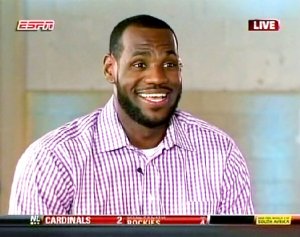
A Smiling, Insensitive, Immature Jerk

Unfortunately, after Thursday night’s LeBronalooza on ESPN, I’m not sure whether to feel sorry for LeBron or to vilify him.  I’m not sure because I don’t know whether Thursday’s evening’s televised “Decision” was his idea or his handlers’ idea or some combination of the two.  Either way, LeBron is really dumb, or he took some really dumb advice.  Either way, LeBron’s reputation is in the toilet, and he seems a like an insensitive jerk.

I’m not the only one who thinks LeBron made a mistake.  Mike Wise of  The Washington Post thinks so.  Bill Plaschke of The Los Angeles Times thinks so.  Gene Wojciechowski of ESPN.com thinks so.  Maureen Dowd of The New York Times thinks so.   David Hinckley of The New York Daily News says we should feel “dirty” after watching the show.

Plaschke may have put it best in the opening few words of his column Friday morning, the day after “The Decision:”

LeBron James is the King, all right.

The King of Crass. The King of Callous. The King of Cowardice.

LeBron – from me to you — here’s what you should have done to avoid me and others calling you a “jerk” (or “former hero,” as Dan Gilbert, the Cavs’ owner called you in a letter to Cavs’ fans).

  1. You should have told each team seeking your services of your decision before you went on television.  For me, that is a matter of respect for them as people.
  2. You should have explained your decision to each team.  It could have been as simple as “I want to go to Miami, because I believe that is where I can best win a championship.”
  3. You should have written a letter to the fans of Cleveland to be released concurrently with the television show, explaining your decision and thanking them for the honor of playing for their team.
  4. On the television show, you should have: a) announced your decision in the first few minutes of the show; b) answered interviewer questions about how and why you made your decision; and c) taken fan questions from the audience, via email, or via Twitter.
  5. Immediately after the show, you should have flown to Cleveland to meet with the local media and fans the next day.
  6. Only then, should you have gone to Miami.

    My Sentiments Exactly

Had you followed my recommendations, LeBron, you would have left in a mature fashion with your head held high.

Instead, you pulled a bit of a Bob Irsay, the late owner who snuck the Baltimore Colts out of town to Indianapolis in the middle of the night.  What Irsay did was bad, but you were worse.  You had the gall to sneak out of Cleveland on national television.

Good luck with your decision.  In our capitalist system, it is your right to leave Cleveland for Miami.  But shame on you for how you made that decision and for being an immature, cowardly jerk.  You’ve certainly lost my respect.