No More “Skinny Jeans” or “Fat Jeans” For Me

Over the past week, I have been to Nordstrom twice to shop for clothes for myself.  Two visits in a week is well outside my comfort zone for clothes shopping frequency.  I am a “surgical shopper.”  I know what I want, go to the store, find it, and leave.  I’m sure the salespeople at Nordstrom call me “an easy mark.”  Fastest commissions they’ve ever made.

I visited Nordstrom in order to retool my wardrobe during their annual sale.  Timing of the sale was perfect for me.  Two pairs of my dress pants recently wore through in the wallet-pocket on my right rear, and my dress shirts are fading and ripping.  Given that items are roughly 33% off during the sale, and I had an opportunity to shop before the sale officially starts, this was the time to retool.  I had avoided shopping long enough.  I bought a sport coat, three pairs of dress slacks, two pairs of casual slacks, five dress shirts, three casual shirts, two belts, nine undershirts, and some dress socks.  I’m eagerly looking forward to the cathartic exercise of cleaning out my closet to make room.

In the process of buying all these clothes, I decided to remove the shackles of the “skinny jeans” and to end the specter of the “fat jeans.”  No longer would I worry about the waist size or the inseam or the collar size.  Instead, I bought clothes that were comfortable and looked good.  Nothing more.
Size Doesn’t Matter Anymore

As I write this, I’m admitting an ugly secret among many men.  Like many women, we have our “skinny jeans” – the pair we always want to fit into when we can finally lose those last five pounds.  I’m also admitting that we have our “fat jeans,” the jeans that are comfortable but that we never, ever want to wear, because wearing them means we desperately need a diet.  As long as the fat jeans are too big, our weight is o.k.

(My wife informed me this evening that “skinny jeans” are now a specific type of jeans.  Who knew?  I’m pushing forward with this posting anyway.)

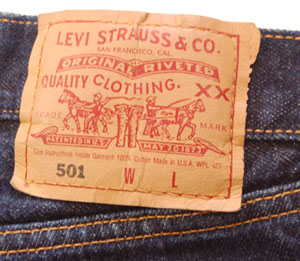
The fact that men have skinny jeans and fat jeans probably isn’t that much of a revelation.  Remember the Seinfeld episode where Jerry so vainly transformed his 32″ Levi’s into 31″ Levi’s just to say he wore the same size as in college?

Any person whose weight fluctuates probably has a wardrobe that ranges in size.  But the desire to wear the skinny jeans and avoid the fat jeans often results in stuffing ourselves into clothes that are uncomfortable.  It results in bloated closet shelves with items we can’t and don’t wear.  I know I have been guilty of that.

I made the decision to eliminate my skinny and fat jeans for four reasons:

  1. I just had my annual physical and the blood tests came back with great results.  I may be heavier than I want, but I’m healthy.  I’m proud of being healthy.  It’s o.k. to be the clothes’ size I really am.
  2. Life is too short to worry about fitting into this or fitting into that.  I’m not obese, and I am not in health danger from my weight.  I want to be comfortable for the rest of my life.
  3. Having a closet that only has clothes that fit you and that you wear is something unique and special.  I’ll credit Gretchen Rubin and her Happiness Project for that revelation.
  4. It dawned on me that, no matter what I think, when I’m wearing stuff that is too small or too large, everyone knows.  Who am I fooling?

We’ll see how it goes.  I’m sure, if nothing else, I’ll enjoy the comfort.

———————–
I weighed myself this morning for the first time in two weeks.  I was at 192.6, which is basically steady, despite seemingly eating too much and exercising too little.  It goes to show that, if you eat smartly, you can still eat a lot and maintain your weight.
Three Days After “The Decision” — LeBron is Still an Immature Jerk

I am a capitalist at heart.  I have said many times that, if someone wants to sell dog shit by the side of the road, and someone else will pay for it, then good for all.

As such, I have no problems with LeBron James’ decision to leave the Cleveland Cavaliers and join the Miami Heat.  He was unencumbered by any restrictions and will go to work where he wants, at a salary he wants, to play with whom he wants.  LeBron doesn’t have to explain his decision, for it’s his to make.  His decision is no different from any of us deciding what job to take or where to live.

A Smiling, Insensitive, Immature Jerk

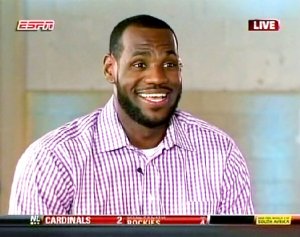
Unfortunately, after Thursday night’s LeBronalooza on ESPN, I’m not sure whether to feel sorry for LeBron or to vilify him.  I’m not sure because I don’t know whether Thursday’s evening’s televised “Decision” was his idea or his handlers’ idea or some combination of the two.  Either way, LeBron is really dumb, or he took some really dumb advice.  Either way, LeBron’s reputation is in the toilet, and he seems a like an insensitive jerk.

I’m not the only one who thinks LeBron made a mistake.  Mike Wise of  The Washington Post thinks so.  Bill Plaschke of The Los Angeles Times thinks so.  Gene Wojciechowski of ESPN.com thinks so.  Maureen Dowd of The New York Times thinks so.   David Hinckley of The New York Daily News says we should feel “dirty” after watching the show.

Plaschke may have put it best in the opening few words of his column Friday morning, the day after “The Decision:”

LeBron James is the King, all right.

The King of Crass. The King of Callous. The King of Cowardice.

LeBron – from me to you — here’s what you should have done to avoid me and others calling you a “jerk” (or “former hero,” as Dan Gilbert, the Cavs’ owner called you in a letter to Cavs’ fans).

  1. You should have told each team seeking your services of your decision before you went on television.  For me, that is a matter of respect for them as people.
  2. You should have explained your decision to each team.  It could have been as simple as “I want to go to Miami, because I believe that is where I can best win a championship.”
  3. You should have written a letter to the fans of Cleveland to be released concurrently with the television show, explaining your decision and thanking them for the honor of playing for their team.
  4. On the television show, you should have: a) announced your decision in the first few minutes of the show; b) answered interviewer questions about how and why you made your decision; and c) taken fan questions from the audience, via email, or via Twitter.
  5. Immediately after the show, you should have flown to Cleveland to meet with the local media and fans the next day.
  6. Only then, should you have gone to Miami.

    My Sentiments Exactly

Had you followed my recommendations, LeBron, you would have left in a mature fashion with your head held high.

Instead, you pulled a bit of a Bob Irsay, the late owner who snuck the Baltimore Colts out of town to Indianapolis in the middle of the night.  What Irsay did was bad, but you were worse.  You had the gall to sneak out of Cleveland on national television.

Good luck with your decision.  In our capitalist system, it is your right to leave Cleveland for Miami.  But shame on you for how you made that decision and for being an immature, cowardly jerk.  You’ve certainly lost my respect.

Things About Work I Wish I Knew Earlier – Part 2

(This is the second post in an ongoing series for Friday’s post about work.  These posts are some guidance to others after my 20+ years in companies ranging in size from Fortune 10 to three people.  Topics are presented in no particular order.  Go to the bottom of this post for links to earlier posts.)

#2 Don’t Talk Negatively About Anyone Behind Their Back

There are many reasons not to talk negatively about anyone behind their back, but I think they all boil down to three:

  1. The person you are criticizing will find out.
  2. It makes you look bad.
  3. Not talking negatively makes you look good.

Before you criticize someone behind their back, assume they will find out and consider the repercussions.   Imagine that person coming to your desk and saying “I heard you said [this] about me.  Did you really say that?”   Do you feel comfortable with that person standing in front of you asking that?  Do you want to answer?  If you find yourself saying “sure, I’ll talk to them about it,” then perhaps you should go directly to them for some constructive criticism and keep the topic just between the two of you.

Why will they find out?  They will find out because the person (or people) you are telling will tell someone else what you said or go directly to the person whom you are criticizing.  (You must assume no trust in the workplace, which we’ll talk about next week.) The person you are telling might do so with the best of intentions.  You can imagine them going to the criticized person and saying something innocuous like “You know what?  Fred thought you could have done a better job on that report, and I think he’s right.  I was going to come talk to you as well.”  Although they are trying to help your mutual co-worker, they have revealed you were talking behind their back.  Not good.

Not only do you look bad when the person finds out, but you look bad regardless. You look bad because, as I wrote last week, no one likes a complainer or a negative person.  But here there is more.  Studies have proven that when we criticize someone to others, the negative factors reflect right back on us.  Thus, when you criticize someone for any reason, you open the door to others looking at you in a similar way.  If you say that Bob talks too fast, people wonder if you talk to fast.  If you say Bob dresses badly, people wonder if you dress badly.  In short, you end up looking just as bad as the person you are criticizing.  Why go there?   Leave negative thoughts about you some place else.

Conversely, if you don’t openly criticize people behind their back, your coworkers view you positively, and the hallway gossips have nothing to complain about.  You want to be the one that is viewed as getting along with everyone and liking everyone.  Keep in mind, I’m not telling you not to have negative thoughts about coworkers or that you must like all your coworkers.  I’m suggesting that you avoid criticizing others behind their backs.  Nothing good can come of it.

Never start those conversations yourself. When a group starts to talk about someone not there, either excuse yourself or stay quiet.  If someone provides an obvious opening for you to be critical, don’t fall in the trap.  Here are a two examples of traps that can easily grab you:

Example #1

Them:  Do you really think Fred will survive under the new boss?  Wow, that should be a challenge.

Wrong answer:  I think he can survive.  Fred definitely has his moments where he drives too hard, too fast, but he’s very competent. Even though you’ve closed with a compliment of Fred, your negative comment is just unnecessary and invites the problems we’ve cited above.

Right answer:  I hadn’t thought about it.  I’m sure the two of them will figure it out.

Example #2

Them:  If I ever have to work on another project with Fred, I’m going to kill myself.  What an ignorant, self-centered, jerk!

Wrong answer:  I am so sorry.  I have had my moments with him as well.  As much as I try to ignore him, it doesn’t work. You haven’t been as overt as your co-worker, but you are agreeing with her, which is the same as criticizing Fred.  The door is open for her to say to her boss, “I won’t work with Fred again. [You] feels the same way.”  Ouch.

Right answer:  I am sorry that you are frustrated.  You might talk with Fred or his boss, but that’s your call.  What are you doing for lunch?

Following my advice above is tough.  None of us like everyone with whom we work.  The trick is keeping it to ourselves.

———————————

Previous Posts

1. Don’t Complain or Make Waves.


In Praise of Graphjam

If you work in corporate America or in consulting, then you’ve seen your share of charts and graphs.  Thanks to PowerPoint and Excel, graphing anything has become way too easy.  Why talk about market share or profit growth or sales in text or bullet points, if you can show it in a graph?

Now, with Graphjam, you can express much, much more with the same types of charts.  As a regular creator and viewer of graphs and charts at work, I find Graphjam is a great spot for mid-day comic relief.

Graphjam is part of the Cheezburger network of 49 humor sites that post humorous (sickening?) photos from all different perspectives.  Each site allows users like you and me to post or create our own art and to vote and comment on others’ postings.  The Cheezburger network includes sites such as:

My favorite, however, is Graphjam.  Graphjam allows users to create pie charts, venn diagrams, line graphs, bar charts, and equations that tell a story you want to tell.  One of my recent favorites:

Each of us, however, has our own story that we can tell with a graph.  Here’s one I quickly created that conveys a simple reality.  Have fun making your own.

Royal Caribbean’s Freedom of the Seas: Passenger Tips – Part Two

In last week’s Travel Wednesday post, I detailed five tips for future travelers on Royal Caribbean’s Freedom of the Seas.  My family and I spent a week on the Freedom of the Seas in late May and early June, traveling to Haiti, Grand Cayman, Jamaica and Cozumel.

This week, I conclude my list, with an additional six tips.

1. Get up early if you want lounge chairs near the pool on the days at sea

Despite a “guest conduct policy” that prohibits saving chairs and signs that say attendants will remove personal items left on an unoccupied chair for more than 30 minutes, we never saw any issues with saving chairs.  However, we did see many people disappointed by 9:00am when the only chairs they could find were either in the shade or on deck 12, one level above the pool, where the wind is fierce.  Getting there early is even more critical if you want chairs by the adult pool.  These are premium seats for the quiet and for the chair cushions which aren’t available at other pools.

The Adult Pool on the Freedom of the Seas

Our cruise had two days at sea, and on both days we got up around 8:00 and put out towels, magazines, sun tan lotion and other markers to stake our claim on two lounge chairs near the adult pool.  By the time we finished breakfast and made it up to our seats around 9:30, all the chairs were long gone.  No one had disturbed our stuff, and we settled right in.  We recommend making friends with the people near you, so that you can protect each other’s chairs when you step away for food, a massage, or to gamble.

I’ve seen other reviews that suggest our behavior is revolting and mean-spirited.  Sorry.  I spent a lot of money on this vacation, and I got up early to get the seat I want.  If you want a better chair, get up earlier than me.

2.  Book your own excursions

We booked excursions in Jamaica and in Cozumel on our own, not through RC.  We found both excursions through Trip Advisor and found the reviews to be accurate. In one instance we had a better time and saved money, and in the other we did something that RC doesn’t offer.

On Jamaica, we booked a day-long tour that included climbing Dunn’s River Falls, a tubing trip down the river, and a stop for lunch.  Our guide, Phil Lafayette, kept us entertained with his stories and his narration of the surroundings.  When rain washed out the tubing trip, he took us to nearby areas for more sightseeing, and he reduced the cost.  The cost should have been $55 per adult and $45 per child under 11.  We found similar trips offered by RC that were double the price.  Finding Phil at the dock was easy, and we were one of seven or eight families that did the same thing.  (By the way, if you haven’t climbed Dunn’s River Falls and you are physically able to do so, I highly recommend it.)

On Cozumel, we participated in the Amazing Cozumel Race.  This is offered by Carnival, but not yet by RC, so we booked it ourselves.  We walked, swam, and ran 3.5 miles through and around downtown Cozumel in 90 minutes, moving from clue to clue as in the television show Amazing Race.  We finished third, behind a group of four 20-somethings and behind another family with older kids.  It was nearly 100 degrees, but, except for a bit of family bickering at the clues, we really enjoyed ourselves.  The race was inventive and challenging.  The cost for the four of us was $268.

3. Get private lessons on the Flowrider

The Flowrider lives up to expectations.  Located on deck 12 at the rear of the ship, the Flowrider is a “ride” in which water pulsating very fast up an incline provides resistance to allow “riders” to surf or boogie board.  As you might imagine, the lines get very long, especially during the days at sea.  At about five minutes per surfer or boogie boarder, it takes a while to get through the line.

For $60 per person, you can take private lessons on the Flowrider.  We signed our son up for surfing and our daughter up for boogie boarding.  At 9:00pm on the second night, they had one-on-one instruction in a group.  For example, my son was one of four surfers for the hour, but each time he was up, he worked directly with an instructor.  During the lessons, the surfers and boogie boarders can use the whole Flowrider each time, whereas during the day, the Flowrider is divided in half to allow more people to use it.  After the lessons, both kids qualified to attend “expert sessions” early in the morning when lines are shorter.  We can’t recommend these lessons enough.  Below is video from our kids lessons.

4. Get a “cabana chair” in Haiti

Unfortunately, we found information lacking about RC’s private beach at Labadee, Haiti.  We checked for maps at guest services and asked around, but could learn almost nothing.  The head of the excursions desk on deck 5 knew zero!  I want to pass one thing on to you.

When you get off this ship, go straight and take the path almost as far as you can take it.  By walking straight and far, you come to a less rocky area, from which you can swim.  However, you will also find “cabana” chairs.  These are two normal chairs pushed under a half-moon, umbrella like cover that provides shade and a bit of privacy.  They are first-come, first-serve.  If you don’t care about swimming, then find some shade under a tree.  But, if you want to swim and want shade to relax, go directly for a cabana chair.

5. Return to the ship earlier than normal in Grand Cayman

Grand Cayman is a tender port.  This means that you go from ship to tender (a boat) to the shore.  At all other ports, you can just walk off the ship.  These tenders become natural bottleneck as they fill up with passengers and leave the dock.  The line quickly gets long and winds through the port area.  When the sun is hot and the line moves slowly, it’s no fun.  If we had to do it over again, we’d head back to the boat on the earlier side to avoid the lines and take advantage of quiet on board ship.

6. Depart on your own terms.

After going through departure, I have two tips.

First, don’t forget to fill out your departure times on a slip in the room.  We forgot and ended up in group 20, which was scheduled to leave at 8:30am.  We were in no rush, but 8:30 was just too late.  There is commotion all over the ship.  As a result, it’s nearly impossible to sleep late.  I recommend something around 7:30 or 7:45.  Remember to fill out your forms and leave on the earlier side.

Second, if you are antsy, you don’t have to wait for your number to be called to leave.  The departure group numbers are the order in which luggage is delivered to the baggage area.  It is not a limiting factor on when you can leave the ship.  If you are in group 20 and want to leave with group 1, you can.  However, you are stuck in the baggage area until your bags come out.  Although we were group 20, we departed when they called group 15, and only  had to wait a short time for our bags.  Not one person asked us what our group number was except the person directing us to the right luggage carousel.

I hope this week’s and last week’s tips are helpful.  If you have other questions, post a comment and I’ll answer as best I can.

Parents, Kids, and Concerts – The Cycle Continues

Last week, I wrote my Tuesday Family post about being embarrassed when I called the band 311 “Three-One-One” and not “Three-Eleven.”  This week, my son attended the 311 concert, and the event triggered yet another moment where I became my parents, even if just for an instant.

The 311 concert, which also included the bands Offspring and Pepper, took place this past Friday at the Verizon Wireless Amphitheater, a spring/summer outdoor venue near St. Louis where you can get reserved seats or you can sit on the “lawn,” which in this case is simply a very large hill.  My wife purchased 8 tickets for my son and his friends for his birthday, as he turns 15 in less than a week.  (Before you think “wow, that’s an expensive party,” you should know there were price breaks on four-ticket blocks.)

Concerts -- From Dad in 1981 . . .

This wasn’t the first concert our son attended.  In 2008 and 2009, he attended something called “Pointfest,” which is a day/evening long concert event sponsored by 105.7 The Point, a local radio station, at the same Verizon Wireless Amphitheater. Both those times, however, a parents of one of his friends spent the day at the concert as a sort of chaperon.  I also took him and two friends to see AC/DC at the Scottrade Center in early 2009.  This time, however, he was going without a chaperon, and that was a bit scary for me.

Going to a concert without a chaperon is certainly not a major milestone in one’s life, such as a bar mitzvah, graduation or driver’s license, but it did cause me to pause to recall my own concert history.  While in high school, I saw Bruce Springsteen twice (The River and then Born in the USA), The Rolling Stones Tattoo You tour, and The Who (1st farewell tour!!).  I also will admit to seeing Journey and The Cars.  All of these concerts were in the old Capital Centre outside Washington, D.C., and none were attended by my parents.

So, as my wife and I sped away after dropping off my son and friends, I had three thoughts.  First, I wondered, “What type of crazy music is this?”  Second, I thought, “Drug dealers are going to descend upon him.”  Third, I realized, “God, I’ve become my parents yet again.”

I really didn’t want to be negative about my son’s music tastes.  His tastes don’t have to mimic mine.  Never mind that I had never heard of 311 or Offspring (again – see last week’s post).  The rosters of the two Pointfests he attended were rife with bands that I had never heard of.  In May 2008, the headliners were Serj Tankian, Shinedown, Killswitch Engage and Filter.  In May 2009, the headliners were Seether, Shinedown (again!), Puddle of Mudd, Bullet for My Valentine, and Apocalyptica.  For me, these don’t have the same cache as Bruce Springsteen or The Who.  At least my parents knew who they were when I attended those bands’ concerts.

. . . to Son in 2010

But, in doing research for this post, I also looked at the roster for the first Pointfest in 1993.   Bands I know played:  They Might Be Giants, Midnight Oil, and Aimee Mann (from ‘Til Tuesday).  In 1994, the Violent Femmes and the Smithereens played.  (Wait!  I have their albums.)   The Ramones played in 1995, and Cheap Trick played in 1996.  Most interesting, however, is that 311 played Pointfest in 1994, 1996 and 2000.  I may not know 311 or their music, but there isn’t be any question that they have a following and some staying power.

I decided not to make any assumptions based on ignorance.  I had visions of my grandparents making similar judgments about Elvis or the Beatles.

As far at the drug dealers, I had some legitimate concerns.  In my concert-going days, I had experienced witnessed joints being passed up and down rows.  Then at the AC/DC concert, two guys in front of us lit up what smelled like pot (or so I’m told).   I really didn’t know what to expect last weekend.  This became one of those moments of trust, where, as a parent, you have to assume that you’ve raised your kids well.  I guess my folks trusted me.

Sure enough, when we returned to pick up the kids four hours later, I picked up the scent of pot (or what I’m told is the scent) in the parking lot as we waited.  Our son and his friends emerged and looked no worse for wear.  They were tired and a bit deaf, but not the least bit under the influence of anything.

So the cycle of concerts began anew – from the Stones to the Who to Bruce Springsteen to . . . 311 and the Offspring?  Maybe so.

Using Committment Bonds to Lose Weight

(Last week, I wrote about “Lose It,” an iPhone app I recommend.  This week, I want to introduce you to a second weight loss tool.)

At the end of 2008, I decided that I needed to lose weight.  It was time.  Clothes were too tight and, as someone who had turned 42 just a few months earlier, I was starting to think about being around for my kids and grandkids, etc.

I had inner motivation to succeed, but I didn’t have any real “kicks in the butt,” such as an upcoming event or, thankfully, drastic health problems.  Through work, I was introduced to a web site called “Stickk.com” and became convinced that this site could offer the motivation that I needed.  In the end, it did.

Stickk.com provides a mechanism through which people like you and me can make commitment bonds.  In a commitment bond, we agree to do something on a regular basis.  It might be exercising, walking the dog, reading to your kids or studying for the bar.  If we don’t live up to our commitment, then we agree to pay a certain amount of money.  Stickk.com allows you to select your goals, the time frame, and your amount donated, and offers options for payment, be it to a charity or to another person against whom you are competing.

In my case, I agreed to a commitment bond (Stickk.com calls them “contracts”) to lose one pound a week for 20 weeks.  If I didn’t stay on pace towards my goal, I would contribute $75 for each week I was behind.  When I weighed myself each Thursday, I updated my weight at the site, and my wife (the “referee”) validated the entry.

The notion of a commitment bond is based on a scientific concept called “loss aversion.”  Loss aversion is the fact that we feel the pain of loss more than we do the joy of a gain.  In terms of weight loss, loss aversion suggests that paying me $75 to lose a pound a week is a great incentive, but it isn’t as much of an incentive as taking away $75 if I don’t stay on pace.

Not convinced?  Think about it this way:

  • I start both diets even, no money gained, no money lost.
  • If I sign up for a reward program and decide to stray off plan, I’m really no worse off.  I never had the money in the first place.
  • If I sign up for a commitment bond and decide to stray off plan, I am worse off.  I’m out money.  I have greater motivation and incentive.

Stickk.com has three other features that are intriguing.

  1. It offers basic community functionality.  This was important to me, because I told friends and relatives about my goals and encouraged them to sign up as a Stickk.com supporter.  Once they registered, they received emails telling them about my success or failure.  Who wants to fail in the eyes of friends and relatives?
  2. It allows donations to charities, but also to “anti-charities.”  If it’s more motivation, you can agree to donate, for example, to the Clinton Presidential Library or the Bush Presidential Library, one of which is likely an anti-charity for you.
  3. When you sign up for a commitment bond, you give your credit card number, so the money is automatically deducted when you fail to miss a goal.

There is no doubt that some payment programs work for people to lose weight.  And certainly commitment bonds at Stickk.com are based on honesty in reporting.  Cheating can, and does occur. But, if you take the commitment bond seriously, invite friends as online “supporters,” and sign up for a meaningful amount ($75 per week would hurt me), I think this is great motivation.

How did it work for me?  I lost 20 pound in 20 weeks with a total payout of $75.  Some days, I exercised morning and evening, just so I didn’t have to payout that money.

Golfing With My Parents on July 4

On this July 4, it’s time to take a break from the World Cup, from free agency in both the NBA and NHL, and from the discussion of whether Stephen Strasburg should be in baseball’s all-star game.

Because July 4 is a day that families spend together, I’ve decided to post about the round of golf I played with my son and parents in Delaware. It was a six-hour (!) round of golf in a hot, humid, bug-infested environment.  But it was also an example of sport bringing together multiple family generations.

The golf wasn’t good. My dad shot 108, and he was at least 10 strokes better than me. I had given up scoring on the fourth hole, so I honestly don’t know my score.

The View from the Driving Range on July 4

I had some real Caddyshack moments on the course.  At first, I felt like we were at Bushwood Country Club itself when loud music blared from across the cove as I and my collared shirt grabbed golf balls from a well-formed pyramid on the driving range. Get the picture?

My son played like Judge Smails’ nephew Spaulding (Sorry, Caddyshack aficionados, that’s the only similarity). And my dad was a bit like Judge Smails himself, in that he’s a stickler for the rules and for fast play.

But, to be fair, the day was about the time we spent together.

It was about my son and his grandma riding in the same cart (she with lit Marlboro menthol in hand) and laughing as she explains what a FISH golf shot is (fuck it’s still here).

It was about my dad, just like a dad should,  telling me that it was ok when I plunked one in the water (never mind I’m 43 and didn’t really care about the lost ball).

It was about my mom, just like a mom should, telling me not to drink beer on the course because it dehydrated you (I drunk one anyway).

It was about my son, just like a 15-year-old should, actively and loudly washing his ball as his grandma tried to tee off.  His grandma said it was ok, and his grandpa took the opportunity explain golf etiquette, just like they each should.

And it was about the sneer my mom gave me when I asked if my son could drive the cart, which is against club rules, yet happily letting him drive a few holes later, just as a grandma should.

There was no family celebration over a hole-in-one or even a chip-in. There was no emotional hug on the 18th green. By the time my dad and I putted out on 18, my mom and son were safely in my folks’ air-conditioned house, having left after the 13th hole.

I left the course knowing that my son will remember this day with his grandparents, just as I remember a day driving the cart for my dad’s dad. And someday, when I play golf with him and his son or daughter, he’ll tell them about this day with fond memories.

He’ll probably compare me to my dad or my mom or both. I will probably deserve it. That will be fine with me.

Things About Work I Wish I Knew Earlier – Part 1

(This is the first post in an ongoing series for Friday’s post about work.  These posts are some guidance to others after my 20+ years in companies ranging in size from Fortune 10 to three people.  Topics are presented in no particular order.)

#1 -Don’t Complain or Make Waves

Seems obvious, right?  No one likes a complainer.

What I’ve learned, however, is that this is an absolute statement.  Never complain about anything or even joke complain about anything.  Seriously.

  • Don’t like the food in the cafeteria?  Don’t tell anyone.  Don’t eat there or find something you like.
  • Think the elevator is slow?  Don’t even joke about it.  Take the stairs.
  • Don’t like the pens the company provides you?  Don’t say a word.  Buy your own.
  • Think your boss dresses poorly?  Keep that to yourself.  Deal with it.

I’ve learned that you can’t “joke complain” because there is truth at the root of all jokes and people know that. A joke complaint is when you say “Can they give me a smaller office?” as you pat your colleague on the back.

I’ve learned that you can’t “soft pedal” a complaint for the same reason.  You soft pedal a complaint when you say “You know, it’s not that big of a deal, but I wish we all had bigger offices.”

No one likes a complainer, because being with a complainer becomes tedious.  No one likes a complainer, because no one wants to be reminded of their own frustrations or complaints.  No one likes a complainer, because inevitably a complainer complains about a decision you made or a close friend made.

Your goal should be to have someone say the following about you:

I don’t know how he does it, but [you] never seems frustrated by anything around here.  It’s amazing that he never says anything negative about anything.  What a great guy.

When other describe you like that, they want you on their team, and they want you in their company.  They want to give you more work, and they want to promote you.

If you are like me, you will be frustrated.  Not complaining,  however, will get you a long way.

In Praise of Upgrd.com

Following up on Travel Wednesday, I’m going to focus this Blogosphere Thursday post on a travel blog worth visiting.

I’d like to stipulate that I really like to travel.  It’s not just about the destination for me, it’s about the experience.  I don’t really mind the lines or the process.

I’ve been fortunate in that business travel has often allowed me to collect enough miles to earn status privileges (silver, gold, platinum, etc.) on airlines.  This lets me board early, get upgrades and bonus miles.  With the miles I earn, I’m often able to redeem them for first class travel.  To me, the whole frequent flyer thing is a game and a challenge.  I like figuring out how to collect more miles to get even better status to get even more perks.

If you are like me, you need to follow the group of guys at Upgrd.com.  I wish I could recall how I stumbled upon this site, but I’m happy I did.  I also listen to their podcast where the personalities of the key participants (Matthew, Mike, Ben, Hunter, Josh, Fozz, and Gary) all come out.

So, what can you learn from Upgrd.com?

  1. Ins and outs of the various frequent flyer programs, including how to redeem, how to get bonus miles, what status levels get you, and what to do with your miles in the case of an airline merger.
  2. How to make sure you get an upgrade, which is a whole science in itself.
  3. Why volunteering to take a later flight when yours is oversold can be a good thing and how many miles to request.
  4. All about “mileage runs” and how to build them.  A “mileage run” is a trip someone takes only to earn miles.  There is a rule of thumb that if your miles “cost” less than 3 cents (cost of fare divided by # of miles), then it’s a good deal.  It may be worth spending a day, for example, on a quick round trip between St. Louis and Los Angeles.
  5. Descriptions of the various cabins on different airlines, airport clubs, hotels, etc.
  6. Stories about the traveling experience.

As an example of something I’ve learned recently —  Delta now has a special only out of St. Louis and a few other cities that lets you get your status faster and provides bonus miles.  To get that, however, you have to sign up for the program.  I did, thanks to a tweet from Gary at Upgrd.com.  Because I’m based in St. Louis, and we have to connect to get anywhere, I’ll be tempted to make the next trip on Delta to maximize the miles as long as it doesn’t take me too far out of my way.

Another thing I learned from these guys are the concepts of “status matching” and “status challenges.”  Status matching occurs when one airline matches the status you’ve earned at another, usually as an incentive to get you to fly them.  When I got to Continental Platinum last year, I was able to get Delta Platinum in just 24 hours with a simple email – and I hadn’t flown Delta in years.  Status challenges allow you to get to status levels faster by flying a large amount of miles in a short time (and paying a small fee).  Challenges are good if you’re flying patterns move you to a different airline for an extended period, such as when you start servicing a new client or are on a new project in other cities.

For those of you that don’t think about all this stuff, but fly a lot, it may be worth visiting and possibly subscribing to the boys at Upgrd.com.