Our New Las Vegas Vacation Diet

Mrs. Spidey and I are finishing up a four-day vacation in Las Vegas. We’re staying at the new Aria hotel in City Center, and I’ll have more on that in Wednesday’s travel post.

We like Las Vegas. We’ve been here about once each year in the recent past, usually while our kids are off at summer camp.  Over the years, we’ve stayed at ten different hotels on the strip. We like sitting by the pool and relaxing. We like gambling a bit. We like the food, and we like the spas.

While we aren’t newbies and know our way around, I know we are more like the average tourist.  We aren’t high stakes gamblers, preferring slot machines over table games.  We aren’t in for the weekend from Southern California solely to party.  We don’t stay out often much past 1:00am, and, if we do, it’s because I’m in the casino playing lower denomination slots.

And, like most other average tourists, we’re watching both our bottom lines and our waist lines.  I think this year we may have figured out one easy way to do both and enjoy ourselves.

(As a quick side note – if you think you are overweight and want to feel good about yourself, come to Las Vegas.  I think all the stock footage the networks use when talking about obesity was shot here.  If you don’t think Americans, on average, needs to lose some pounds, come to Las Vegas.)

Not eating is not the answer to watching your finances and your calories.  On our trips, we have eaten at some very good and very expensive restaurants. We’ve eaten at Alex at the Wynn and Sinatra’s at the Encore. We’ve also eaten at both Capital Grille and Morton‘s here, and the restaurant up in the Eiffel Tower at Paris. We also ate at the now-closed Commander’s Palace in about 2005, when it was still at the Alladin, which has since morphed to Planet Hollywood.

Our new Las Vegas Vacation Diet has five parts:

  1. Eat a big breakfast at a buffet sometime after 9:30.  Take a few pieces of fruit or cookies with you for snacks later.
  2. Hit the hotel spa/gym in the afternoon for a workout.  (This may be the most critical step.)
  3. Snack on the free apples, oranges and drinks in the spa.
  4. Eat dinner at about 7:oo or so at a buffet.  Again, take a piece of fruit or two for later.
  5. Walk up and down the strip, avoid taxis where possible.  (For example, you can’t really walk to Rio, the Palms, or Hard Rock.)

No, I’m not nuts for including two buffets as part of a diet.  First, I’m not assuming you will lose weight in Las Vegas.  That’s stupid.  Of course you won’t. The challenge is to limit how much you gain.  Second, if you have willpower and stop when you are full, buffets at the better hotels do have good food and good variety.

Thanks to the good people at Harrah’s, there is also a great economical way to make this happen.  They’ve introduced something call the Buffet of Buffets.  For $40 (after joining their Total Rewards frequent player program – which is free), a person can eat at seven different buffets under the Harrah’s umbrella for 24 hours.  This isn’t three meals, this is legitimately unlimited.  You can slip in any time for a dish of ice cream or banana, although be wary of long lines to be seated, as you can’t avoid them.  You do not have to stay at one of their hotels to be eligible.

We went to Paris for brunch on Sunday morning and purchased our 24-hours worth there.  (We did pay $10 more per person to cut the ridiculously large line.)  We strategized to eat breakfast a bit later, so we’d have time on Monday morning to eat breakfast again within the 24 hours.  We later had dinner at Planet Hollywood and breakfast Monday at the Flamingo.  Of course, if you want to have lunch as well, you can.  We were still full from breakfast nearly to dinner time.

You need to factor the spa/gym cost into your equation.  Here at the Aria it’s $30 per day ($80 for three), but that includes the drinks and food noted above, plus sauna, steam room, whirlpools, towels, robes, etc.  We recommend a workout followed by at least 90 minutes of relaxation up in the spa.

That nets to $70 per person per day for food and exercise, not including tips.  We challenge you to eat three meals here for under $70 per day without going to McDonald’s or something else you can find back at home.

We didn’t follow this diet two days in a row because, honestly, we can’t take buffets that many times in a row for dinner.  As noted above, we do like good restaurants.  We also like breakfast buffets, which is why we chose to start our 24 hours in the morning.   However, if you can take buffets at every meal, then, thanks to Harrah’s, you can utilize this New Las Vegas Vacation Diet for your entire stay and watch your bottom line and your waistline.

The Day I Gave George Steinbrenner Advice

George Steinbrenner and I have two things in common. We are both alums of Williams College, 1952 and 1988 respectively, and we both love the New York Yankees.

The former brought us together in the fall of 1984.

I was a freshman at Williams then. Both my freshman roommates played football. Both were running backs. I don’t think either played all four years, but on this day, homecoming 1984, my roommate Kenny started at halfback against our arch rival Amherst.

The record shows that Williams lost that day 23-6 and that Amherst completed an undefeated season. It wasn’t until my senior year that we next beat Amherst in football, starting a streak of eight victories in a row.

I’ll remember that day, however, because that day I gave George Steinbrenner advice about the Yankees.

I had found a spot in the stands around the 40-yard line, wanting to watch Ken, rather than join the tailgaters just off the end zone at Weston Field. At the start of the first quarter, George sat down next to me.

I had been a Yankee fan since elementary school. We had no team in D.C., the Senators having left for Texas when I was 4. I didn’t like the Orioles, even though everyone said I should, because Baltimore was the closest city to us with a baseball team.  Instead, I decided to root for the Orioles’ rivals, the Yankees.

And there I was in November 1984, a Yankee fan sitting next to The Boss. An 18-year-old kid with clear opinions about his favorite baseball team had the ear of that team’s controversial owner. Way cool.

I nodded and said hello. He asked how the team was doing. I said ok, and I pointed out Kenny and told George that Kenny was my roommate. George watched and said some nice things about Kenny’s performance. He was cordial and friendly.

Steinbrenner and Winfield in 1989 – 5 Years After I Told George Not to Trade Him

Nothing else stands out in my memory until halftime. As everyone got up to go get a cocktail or beer, I said to George, “Don’t trade Dave Winfield.” (Sportswriters then were suggesting that might happen.) George chuckled and replied back, “I’ll see what I can do.”

The sports almanacs show that, indeed, Winfield was not traded from the Yankees that off-season.  The following season (1985), Winfield was an All-Star, and won a Gold Glove and Silver Slugger award. As this New York Times article from 2008 explains, Winfield and Steinbrenner would have some trying times, but finally reconciled in recent years.  As a fan, I never knew what happened behind the scenes.  I just wanted to see Winfield in right field wearing number 31 for the Yankees.

After talking to George that November day and relaying my opinion, I got to see #31 in the Yankees line-up until 1990, when he was traded to the Angels.

Rest in peace, George.

Thanks for listening. I’m glad I could help, and thanks, as a fan, for following my advice.

Things About Work I Wish I Knew Earlier – Part 3

Third in a series.  Links to earlier parts can be found at the bottom of this post.

#3 Don’t Ask Questions in Large Meetings

Every company I’ve been with has special meetings.  These meetings are held to talk about results, plan for next year, introduce new products or services, hold training, etc.  The difference between these meetings and more run-of-the-mill meetings is that they are generally non-participatory.  Speakers speak and presenters present, but these meetings aren’t sites for group discussion and debate.  I think you get the picture.

Inevitably, at the end of each presentation, at the end of a day, or at the end of a multi-day conference, the emcee will say “Are there any questions?”  When that happens, I recommend that you sit quietly with your hands folded on the table.

Am I a bit cynical?  Yes.  For me, this boils down to a question of risk versus reward.  For me, the rewards are small, and the risks are great.  If you really, really have a question, then wait until after the meeting and ask your boss.  That should be your plan.

Let’s look at the risks and rewards of asking a question in a room with anywhere from 50 to 1,000 people.

Rewards:

  • More people know who you are. You almost always have to say your name and where you are from when you rise to ask a question.  This is irrelevant, of course, for small companies where everyone knows everyone anyway.
  • People know you are brave and take risks. Some people just don’t have the gumption to ask the CEO of a Fortune 500 company a question.
  • You get an answer to a question and others may have wanted to ask the same question. Sometimes, you just ask the right question, for the audience and the speaker.

Risks:

  • More people know who you are. Do you want to be discovered because people see you asking a question at a meeting or because you do great work and build relationships?  Don’t let this be the first or major impression of you that others have.
  • People know you are brave and take risks. For many managers, they want someone who is a bit more serene, a bit more controlled.  They view speaking out at these meetings as a negative.
  • You get an answer to a question and other may have wanted to ask the same question. This is a bit like the old Life cereal commercials.  “Let’s get Mikey to ask.  He’ll ask anything.”  It is not good to be known as the one who will always ask questions.

Do you see a pattern here?  There are more risks:

  • You hit a hot button. Even with best intentions, you ask the wrong question and the answerer reacts negatively.
  • You throw up a “softball” question and are seen as a brown nose. “Sir, why do you think this is a great place to work?”
  • You are viewed as a trouble-maker or as outspoken. “Maggie always asks a question.  Can’t she just leave well enough alone?”

And here’s the thing — no one ever forgets.  Think about your own company for a second.  Who asks questions at big meetings?  I’ll be you can name one or two people instantly, can’t you?

With the risks outweighing the rewards and people never forgetting who asked the questions (even good questions), I’ve learned that it’s better to let others ask, sit quietly, and, if needed, talk to your boss or a confidante later.

——————-
Previous parts:

#1 Don’t Complain or Make Waves
#2 Don’t Talk Negatively About Anyone Behind Their Back

In Praise of Kayak

If you read my blog (and I hope you are a return reader), you know I travel a lot and that I like to travel.  (If you are a first time reader, check Wednesday’s posts for more on travel).

For this Thursday’s “Site I Like” post, I thought I might write a few words in support of Kayak, which is my go-to site for checking airfares and hotel rates.

You may have seen some Kayak ads on television in the recent past, but those are relatively new. It’s trademark, visible in the ads, is a board that changes destinations like those old arrival and departure boards in airports and train stations.  Despite the advertising, Kayak has mostly flown under the radar.

Because most of my travel is for work, and we have a corporate travel agent, I use Kayak exclusively to find out what routes exist and what low fares exist.  I have to use my travel agent to book.  I can’t comment on the purchase process on Kayak.

One of Kayak’s great features is that is allows you to easily narrow your travel preferences to focus on your best options, including:

Kayak TV Ad -- The Image of the Destination Board in the Background

  • Your preferred take off and landing times for each leg by sliding a button down a bar – much easier than a drop down box
  • Your preferred airline or airlines or airline alliance (Star Alliance, OneWorld or Sky Team)
  • The total length airport to airport of your flight, including lay overs
  • The length of your lay over (I hate short layovers.  I like at least an hour.)

Kayak lists all the flights in a list and gives you several options to sort.  At first, it shows you just the departure to destination times of all options.  You decide if you want details like the flight numbers, the layovers, the fees, etc. and on which site the price is available. This allows you to do a quick scan of the best options.  I usually sort by total flight time and try to find something near the top of that list.

Another neat feature is that Kayak allows you to find all trip options based on one specific flight.  For example, if I’m traveling from St. Louis to Beijing and back, and I know I want a specific return flight from Beijing, I can find that flight and tell Kayak to show me all itineraries with that return flight.  This feature in particular is one that other sites need to have.  I often want to build my own itinerary, but don’t have that option elsewhere.

For comparison shoppers, Kayak will search five other sites simultaneously, including Priceline and Expedia.  I don’t use that feature much, because I’m so comfortable with Kayak, but I can see where it might interesting to travelers.

Kayak’s hotel search is similar, in that it presents the information in a simple list, letting you decide what details you want to see.  You can narrow the search based on brand of hotel, # of stars, price and amenities or any of many combinations.

Again – Kayak works for me, especially in terms of how quickly I can scan and sort options.  Other sites may work for you.  But, if you haven’t visited Kayak and you tend to research fares, you really should give Kayak a try.

Please Don’t Do This on My Plane Ride

For this week’s travel post, I thought I might run down a few things that I highly recommend you don’t do on an airplane.  I’ve traveled for every job I’ve ever had.  For some, I’ve traveled every week.  I’ve been packed in the center seat between New York and London on a 747 and in first class on a 777 from Berlin to DC.  I’m not afraid, like some, to fly Southwest and remember to get my A boarding pass 24-hours early.

Don’t Show Me Your Bare Feet

I have no issue with people wearing sandals, flip-flops or other shoes without socks.  I wear flip-flops almost exclusively from May through September, except when I’m at work.  I don’t mind if you slip them off on the plane.  I just don’t want to know.  Don’t cross your legs and put your foot up at armrest level, almost touching me.  And please, please don’t put your bare foot on the armrest when you sit behind me, so that your toes brush against my elbow.  Yuk!  I borrowed the photo at right from my friends at upgrd.com, who experienced something very similar last fall.

Please Don't Do This!

Don’t Bring Smelly Food on Board

Seriously.  No one wants to smell your tuna or your Italian sub.  You don’t think we can?  Bring a PB&J, or chips.  It was awful to smell Lynch Parsons’ liverwurst in 2nd grade, and it’s awful to smell your stuff now.  At least in 2nd grade, I could sit on the other side of the cafeteria.  I can’t move when I’m on a plane.

Don’t Eat Food with Disposable Parts

I wasn’t sure how to name this.  I once sat on a plane from St. Louis to Orlando in an aisle seat.  Right across the aisle from me, a guy ate sunflower seeds the entire trip.  He put one in his mouth, bit it, reached into his mouth to grab the shell, and put the shell on a napkin on his tray.  I appreciate his neatness, but after 45 minutes he had a nice large pile of wet sunflower seed remnants.  It was disgusting.  Don’t do this.  Don’t bring peanuts or anything like this.

Don’t Expect Your Child to Entertain Themselves

I am constantly amazed at the people who travel with kids that bring nothing to keep the kids entertained.  No coloring books.  No toys.  No books to read.  No DVD player.  No nothing.  When was the last time a 5-year-old sat still for an hour?  Never.  As a result, they kick the back of my seat or cry a lot.  I’m a parent of two, and my kids have flown since they were in baby carriers.  My wife, bless her, always prepared for every trip with stuff.  Once, we flew from Baltimore to Honolulu for my sister’s wedding via Detroit and San Francisco.  My kids were 4 and 1 1/2.  My wife packed wrapped presents to be open about every 90 minutes.  My kids didn’t bother anyone.

Don’t Hog the Arm Rest or Think You Can Keep It Up the Whole Trip

This is all about sharing.  You take the armrest for a bit, then I’ll take it, and so on.  I can’t stand it when someone plops down, puts their arms on the armrests,  and doesn’t move for two hours.  Meanwhile, my left or right arm is cramping by the time we land.  (By the way, my wife vehemently disagrees with this.  She thinks the person in the middle seat gets both their armrests as “compensation” for taking that seat.) And for those of you slightly larger that don’t want the armrest down – nope.  You have your space, and I have mine, and the armrest separates that space.  If I sit down, and the armrest isn’t down, it goes down immediately.

Don’t Put Your Baggage Over My Seat, When Your Seat is 20 Rows Back

Your baggage goes over your own seat.  That’s why there’s overhead space above your seat.  The overhead space over my seat is mine.  I’ve actually stopped people from using my space, when I see them do it.  I’m sorry you can’t carry the bag all the way back.  Next time, get a seat farther up front.

Don’t Talk the Whole Trip Behind Me or In Front of Me

I can usually control the conversation in my row.  Sometimes I’m in a talking mood, and sometimes I’m not.  I get frustrated however, when the people in rows around me talk incessantly the whole time.  Rows in coach aren’t that far apart.  Voices carry.  Be sensitive.  Two hours of non-stop chatter gets to me.

Don’t Play Your DVD Without Headphones

You can afford a DVD player but not headphones?  Nothing much more for me to write here.

Don’t Rush Up the Aisle When the Plane Lands

This one kills me.  Where the hell are you going?  Three rows make a difference?  I am amazed when this happens on international flights.  People run up the aisle to save four rows, and they have to go through passport control anyway.  You exit a plan row by row, just like on a school bus.  Be considerate.  When I see someone standing above me that I know came from a few rows back, I stare them down and make sure I get out when it’s my turn.  Sometimes, I’ll even block to let row mates out.

This has been a public service announcement from all the frequent flyers to you infrequent flyers.  Thanks for reading.

What I Learned from Summer Camp

Yesterday at lunch time, my wife and I dragged trunks, backpacks and duffel bags to the JCC here in St. Louis and saw our kids board buses taking them to four-weeks of sleep-away summer camp.  This is my son’s eighth year and my daughter’s fifth.

Where All This Learning Occurred

Our children are carrying on a tradition from their parents and some of their grandparents.  My wife and her mother both went to sleep-away camp.  My dad and I did as well.  I hope some day that my grandchildren will continue the experience.

I went to summer camp from 1974 through 1981, seven of them at Camp Ramblewood located on the Susquehanna River in Darlington, Maryland.  There are some great movies that portray some real aspects of summer camp:  Meatballs, Little Darlings, Wet Hot American Summer, Friday the 13th, and Parent Trap (which is drilled into my subconscious thanks to my daughter).  Ok – maybe Friday the 13th wasn’t based on reality.

We all learned something from those movies, but here are the top 10 things I learned from my eight years of summer camp:

10.  I learned that if you put a normal aerosol top on shaving cream, it creates a fine stream of shaving cream that is perfect for fights.

9.    I learned that it’s possible to stick a fork through your own ear lobe.  This kid named Jeffrey did it one day at lunch, when he impaled himself accidentally while leaning down to pick something up under the table.

Gimp: Does This Exist Outside of Summer Camp?

8.    I learned how create a rat-tail from a towel and put welts on others with a “snap.”  This would have been of great use, had I been cast in Porky’s, but that’s about it.

7.    I learned how to make bracelets out of gimp – in multiple stitches no less.  In the politically correct 21st century, I’m told this is now called “lanyard.”  Does gimp exist anywhere else but summer camp?

6.    I learned how to go commando (and that I didn’t care for it) when Camp Ramblewood lost all my underwear in the laundry in eight weeks.  I can still hear my mother on the phone to camp wondering how a 7-year-old kid can lose all his underwear.

5.    I learned how to do a lot of stuff that I had no opportunity to do elsewhere and have barely done since:  water skiing, riflery, archery, and horseback riding.  I know I haven’t shot a gun since 1981.

4.    I learned how to gamble.  I still owe my friend David Gildenhorn in excess of $2M from a rigged gin rummy game.  How did I ever agree to a progressive game of double or half?  Didn’t I realize I’d never end the debt?

3.    I learned that puppy dog eyes and a mumbled “I have a headache” led to TLC from the attractive infirmary nurse.  (That only worked once a summer, but helped later in life in my social life.)

2.    I learned all there is to know about the birds and the bees.  Conversations with mom & dad?  Nope.  Learn something new in 6th grade health?  No.

1.    I learned independence.  This is important.  Because of summer camp, I easily made the transition to being away from home for college and moving out after graduation.

I’ll add one thing in closing.  I also learned about the ebb and flow of life, about the highs and the lows by going to summer camp.

You see, after first-year jitters in 1974, I eagerly looked forward to camp every year.  I saw the same people from Baltimore, from Philadelphia, and from Cherry Hill, New Jersey each year and went with my friends from D.C.  After 7 years at Camp Ramblewood, I knew the place, the ins, the outs, the rules and how to break them.  Everyone knew me.  Then, in August 1980, just a few weeks after returning from camp, we got a letter in the mail telling us that Camp Ramblewood was closing.  Some of us went to another camp the following year, but it wasn’t the same.  Camp Ramblewood open again a few years later, but is now a corporate retreat.  Bummer.

Perhaps that disappointment makes the memories fonder.  I don’t know.  I do know that I’d go again in a heartbeat, if I could.

No More “Skinny Jeans” or “Fat Jeans” For Me

Over the past week, I have been to Nordstrom twice to shop for clothes for myself.  Two visits in a week is well outside my comfort zone for clothes shopping frequency.  I am a “surgical shopper.”  I know what I want, go to the store, find it, and leave.  I’m sure the salespeople at Nordstrom call me “an easy mark.”  Fastest commissions they’ve ever made.

I visited Nordstrom in order to retool my wardrobe during their annual sale.  Timing of the sale was perfect for me.  Two pairs of my dress pants recently wore through in the wallet-pocket on my right rear, and my dress shirts are fading and ripping.  Given that items are roughly 33% off during the sale, and I had an opportunity to shop before the sale officially starts, this was the time to retool.  I had avoided shopping long enough.  I bought a sport coat, three pairs of dress slacks, two pairs of casual slacks, five dress shirts, three casual shirts, two belts, nine undershirts, and some dress socks.  I’m eagerly looking forward to the cathartic exercise of cleaning out my closet to make room.

In the process of buying all these clothes, I decided to remove the shackles of the “skinny jeans” and to end the specter of the “fat jeans.”  No longer would I worry about the waist size or the inseam or the collar size.  Instead, I bought clothes that were comfortable and looked good.  Nothing more.

Size Doesn’t Matter Anymore

As I write this, I’m admitting an ugly secret among many men.  Like many women, we have our “skinny jeans” – the pair we always want to fit into when we can finally lose those last five pounds.  I’m also admitting that we have our “fat jeans,” the jeans that are comfortable but that we never, ever want to wear, because wearing them means we desperately need a diet.  As long as the fat jeans are too big, our weight is o.k.

(My wife informed me this evening that “skinny jeans” are now a specific type of jeans.  Who knew?  I’m pushing forward with this posting anyway.)

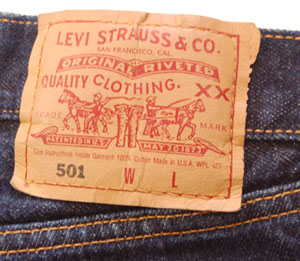
The fact that men have skinny jeans and fat jeans probably isn’t that much of a revelation.  Remember the Seinfeld episode where Jerry so vainly transformed his 32″ Levi’s into 31″ Levi’s just to say he wore the same size as in college?

Any person whose weight fluctuates probably has a wardrobe that ranges in size.  But the desire to wear the skinny jeans and avoid the fat jeans often results in stuffing ourselves into clothes that are uncomfortable.  It results in bloated closet shelves with items we can’t and don’t wear.  I know I have been guilty of that.

I made the decision to eliminate my skinny and fat jeans for four reasons:

  1. I just had my annual physical and the blood tests came back with great results.  I may be heavier than I want, but I’m healthy.  I’m proud of being healthy.  It’s o.k. to be the clothes’ size I really am.
  2. Life is too short to worry about fitting into this or fitting into that.  I’m not obese, and I am not in health danger from my weight.  I want to be comfortable for the rest of my life.
  3. Having a closet that only has clothes that fit you and that you wear is something unique and special.  I’ll credit Gretchen Rubin and her Happiness Project for that revelation.
  4. It dawned on me that, no matter what I think, when I’m wearing stuff that is too small or too large, everyone knows.  Who am I fooling?

We’ll see how it goes.  I’m sure, if nothing else, I’ll enjoy the comfort.

———————–
I weighed myself this morning for the first time in two weeks.  I was at 192.6, which is basically steady, despite seemingly eating too much and exercising too little.  It goes to show that, if you eat smartly, you can still eat a lot and maintain your weight.

Three Days After “The Decision” — LeBron is Still an Immature Jerk

I am a capitalist at heart.  I have said many times that, if someone wants to sell dog shit by the side of the road, and someone else will pay for it, then good for all.

As such, I have no problems with LeBron James’ decision to leave the Cleveland Cavaliers and join the Miami Heat.  He was unencumbered by any restrictions and will go to work where he wants, at a salary he wants, to play with whom he wants.  LeBron doesn’t have to explain his decision, for it’s his to make.  His decision is no different from any of us deciding what job to take or where to live.

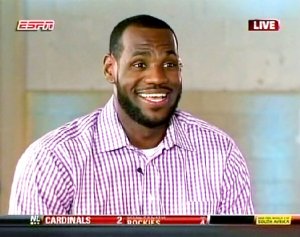
A Smiling, Insensitive, Immature Jerk

Unfortunately, after Thursday night’s LeBronalooza on ESPN, I’m not sure whether to feel sorry for LeBron or to vilify him.  I’m not sure because I don’t know whether Thursday’s evening’s televised “Decision” was his idea or his handlers’ idea or some combination of the two.  Either way, LeBron is really dumb, or he took some really dumb advice.  Either way, LeBron’s reputation is in the toilet, and he seems a like an insensitive jerk.

I’m not the only one who thinks LeBron made a mistake.  Mike Wise of  The Washington Post thinks so.  Bill Plaschke of The Los Angeles Times thinks so.  Gene Wojciechowski of ESPN.com thinks so.  Maureen Dowd of The New York Times thinks so.   David Hinckley of The New York Daily News says we should feel “dirty” after watching the show.

Plaschke may have put it best in the opening few words of his column Friday morning, the day after “The Decision:”

LeBron James is the King, all right.

The King of Crass. The King of Callous. The King of Cowardice.

LeBron – from me to you — here’s what you should have done to avoid me and others calling you a “jerk” (or “former hero,” as Dan Gilbert, the Cavs’ owner called you in a letter to Cavs’ fans).

  1. You should have told each team seeking your services of your decision before you went on television.  For me, that is a matter of respect for them as people.
  2. You should have explained your decision to each team.  It could have been as simple as “I want to go to Miami, because I believe that is where I can best win a championship.”
  3. You should have written a letter to the fans of Cleveland to be released concurrently with the television show, explaining your decision and thanking them for the honor of playing for their team.
  4. On the television show, you should have: a) announced your decision in the first few minutes of the show; b) answered interviewer questions about how and why you made your decision; and c) taken fan questions from the audience, via email, or via Twitter.
  5. Immediately after the show, you should have flown to Cleveland to meet with the local media and fans the next day.
  6. Only then, should you have gone to Miami.

    My Sentiments Exactly

Had you followed my recommendations, LeBron, you would have left in a mature fashion with your head held high.

Instead, you pulled a bit of a Bob Irsay, the late owner who snuck the Baltimore Colts out of town to Indianapolis in the middle of the night.  What Irsay did was bad, but you were worse.  You had the gall to sneak out of Cleveland on national television.

Good luck with your decision.  In our capitalist system, it is your right to leave Cleveland for Miami.  But shame on you for how you made that decision and for being an immature, cowardly jerk.  You’ve certainly lost my respect.

Things About Work I Wish I Knew Earlier – Part 2

(This is the second post in an ongoing series for Friday’s post about work.  These posts are some guidance to others after my 20+ years in companies ranging in size from Fortune 10 to three people.  Topics are presented in no particular order.  Go to the bottom of this post for links to earlier posts.)

#2 Don’t Talk Negatively About Anyone Behind Their Back

There are many reasons not to talk negatively about anyone behind their back, but I think they all boil down to three:

  1. The person you are criticizing will find out.
  2. It makes you look bad.
  3. Not talking negatively makes you look good.

Before you criticize someone behind their back, assume they will find out and consider the repercussions.   Imagine that person coming to your desk and saying “I heard you said [this] about me.  Did you really say that?”   Do you feel comfortable with that person standing in front of you asking that?  Do you want to answer?  If you find yourself saying “sure, I’ll talk to them about it,” then perhaps you should go directly to them for some constructive criticism and keep the topic just between the two of you.

Why will they find out?  They will find out because the person (or people) you are telling will tell someone else what you said or go directly to the person whom you are criticizing.  (You must assume no trust in the workplace, which we’ll talk about next week.) The person you are telling might do so with the best of intentions.  You can imagine them going to the criticized person and saying something innocuous like “You know what?  Fred thought you could have done a better job on that report, and I think he’s right.  I was going to come talk to you as well.”  Although they are trying to help your mutual co-worker, they have revealed you were talking behind their back.  Not good.

Not only do you look bad when the person finds out, but you look bad regardless. You look bad because, as I wrote last week, no one likes a complainer or a negative person.  But here there is more.  Studies have proven that when we criticize someone to others, the negative factors reflect right back on us.  Thus, when you criticize someone for any reason, you open the door to others looking at you in a similar way.  If you say that Bob talks too fast, people wonder if you talk to fast.  If you say Bob dresses badly, people wonder if you dress badly.  In short, you end up looking just as bad as the person you are criticizing.  Why go there?   Leave negative thoughts about you some place else.

Conversely, if you don’t openly criticize people behind their back, your coworkers view you positively, and the hallway gossips have nothing to complain about.  You want to be the one that is viewed as getting along with everyone and liking everyone.  Keep in mind, I’m not telling you not to have negative thoughts about coworkers or that you must like all your coworkers.  I’m suggesting that you avoid criticizing others behind their backs.  Nothing good can come of it.

Never start those conversations yourself. When a group starts to talk about someone not there, either excuse yourself or stay quiet.  If someone provides an obvious opening for you to be critical, don’t fall in the trap.  Here are a two examples of traps that can easily grab you:

Example #1

Them:  Do you really think Fred will survive under the new boss?  Wow, that should be a challenge.

Wrong answer:  I think he can survive.  Fred definitely has his moments where he drives too hard, too fast, but he’s very competent. Even though you’ve closed with a compliment of Fred, your negative comment is just unnecessary and invites the problems we’ve cited above.

Right answer:  I hadn’t thought about it.  I’m sure the two of them will figure it out.

Example #2

Them:  If I ever have to work on another project with Fred, I’m going to kill myself.  What an ignorant, self-centered, jerk!

Wrong answer:  I am so sorry.  I have had my moments with him as well.  As much as I try to ignore him, it doesn’t work. You haven’t been as overt as your co-worker, but you are agreeing with her, which is the same as criticizing Fred.  The door is open for her to say to her boss, “I won’t work with Fred again. [You] feels the same way.”  Ouch.

Right answer:  I am sorry that you are frustrated.  You might talk with Fred or his boss, but that’s your call.  What are you doing for lunch?

Following my advice above is tough.  None of us like everyone with whom we work.  The trick is keeping it to ourselves.

———————————

Previous Posts

1. Don’t Complain or Make Waves.


In Praise of Graphjam

If you work in corporate America or in consulting, then you’ve seen your share of charts and graphs.  Thanks to PowerPoint and Excel, graphing anything has become way too easy.  Why talk about market share or profit growth or sales in text or bullet points, if you can show it in a graph?

Now, with Graphjam, you can express much, much more with the same types of charts.  As a regular creator and viewer of graphs and charts at work, I find Graphjam is a great spot for mid-day comic relief.

Graphjam is part of the Cheezburger network of 49 humor sites that post humorous (sickening?) photos from all different perspectives.  Each site allows users like you and me to post or create our own art and to vote and comment on others’ postings.  The Cheezburger network includes sites such as:

My favorite, however, is Graphjam.  Graphjam allows users to create pie charts, venn diagrams, line graphs, bar charts, and equations that tell a story you want to tell.  One of my recent favorites:

Each of us, however, has our own story that we can tell with a graph.  Here’s one I quickly created that conveys a simple reality.  Have fun making your own.